Scheduled and Recurring Data Transfers
Data Transfer Logistics and Coordination Managed By MLADU Concierge
Data is not always available when an organization is ready to receive it.
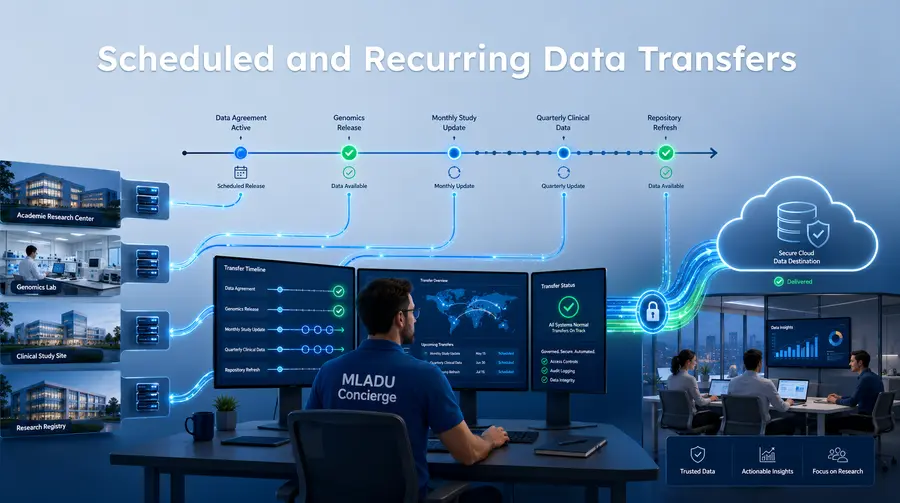
A research data set may be scheduled for release after a study milestone. A data transfer agreement may authorize delivery on a future date. A laboratory may publish new files every month. A research site may submit updated data after each reporting period. A partner organization may not know the exact delivery date until processing, review, or approval is complete.
In each of these situations, someone must track the data, communicate with the source organization, confirm when the files are ready, coordinate the transfer, and make sure the delivery process begins at the appropriate time.
MLADU helps manage this work.
MLADU supports both scheduled and recurring data transfers governed by MLADU Concierge. Instead of requiring clients to repeatedly monitor data availability and manage transfer logistics, MLADU Concierge can coordinate with the data source organization, track when the data becomes available, and initiate the transfer workflow on the client's behalf.
This allows researchers, data teams, project managers, and consortium personnel to focus on their primary work rather than repeatedly managing data delivery schedules.
What Is a Scheduled Data Transfer?
A scheduled data transfer is a transfer planned for a future date, release window, milestone, or availability condition.
The data may not be available when the transfer is initially requested. However, the organizations involved may already know that the data will become available later.
A scheduled transfer may depend on:
- The effective date of a data transfer agreement
- A published data availability date
- Completion of a research milestone
- Approval from a sponsor or data owner
- Release of a new data set
- Completion of laboratory processing
- Completion of data validation or quality review
- A planned partner delivery date
- Availability of source-system access
- Another agreed transfer condition
MLADU can prepare for the transfer in advance and help coordinate its execution when the required conditions have been satisfied.
What Is a Recurring Data Transfer?
A recurring data transfer is a transfer that takes place repeatedly as new or updated data becomes available.
The transfer may occur according to a regular schedule, such as weekly, monthly, or quarterly. In other cases, the timing may depend on when the source organization publishes or approves a new data release.
Examples of recurring data transfers include:
- Monthly research data submissions
- Weekly laboratory result deliveries
- Quarterly clinical data updates
- Periodic genomic sequencing outputs
- Ongoing medical imaging deliveries
- Updated study files from participating research sites
- New data releases from a repository
- Repeated transfers from a sponsor or external partner
- Revised data sets following quality review
- Continuing data collection across a longitudinal study
MLADU Concierge can track these recurring data updates and initiate the appropriate transfer workflow when new files become available.
The Difference Between Scheduled and Recurring Transfers
Scheduled and recurring transfers are related, but they address different needs.
A scheduled transfer is generally planned for a specific future event or availability window. It may occur once.
A recurring transfer happens repeatedly as new or updated data becomes available.
For example, a consortium may schedule the initial transfer of a study data set after a data transfer agreement becomes effective. The consortium may then establish recurring transfers for monthly updates throughout the study.
MLADU can support both stages of that workflow.
How MLADU Concierge Supports Scheduled Transfers
Scheduling a transfer involves more than selecting a date on a calendar.
The source organization must be ready to provide the data. Required access may need to be established. The data may need to pass an internal review. The transfer agreement may need to become effective. Technical information may need to be exchanged between the source and target organizations.
MLADU Concierge helps coordinate these dependencies.
Depending on the transfer arrangement, MLADU Concierge may:
- Communicate directly with the data source organization
- Track the expected data availability date
- Confirm whether the source data is ready
- Follow up when an availability date changes
- Coordinate source and target requirements
- Confirm that required transfer information has been provided
- Track outstanding transfer dependencies
- Prepare the transfer workflow in advance
- Initiate the transfer when the agreed conditions are satisfied
- Keep authorized client stakeholders informed of transfer progress
This helps prevent a future transfer from becoming an overlooked calendar item or a last-minute operational emergency.
How MLADU Concierge Supports Recurring Transfers
Recurring transfers can create a substantial administrative burden.
Without a managed process, a client may need to repeatedly contact the source organization, ask whether new files are available, confirm which files should move, coordinate access, start the transfer, monitor delivery, and follow up on exceptions.
The same work may need to be repeated every week, month, quarter, or data release cycle.
MLADU Concierge helps reduce this burden.
For recurring transfer arrangements, MLADU Concierge can:
- Track expected data release cycles
- Coordinate with the source organization
- Confirm when new or updated files are available
- Monitor changes to the anticipated release schedule
- Initiate the transfer workflow on the client's behalf
- Support communication between source and target stakeholders
- Monitor the transfer after initiation
- Help identify and coordinate the resolution of transfer exceptions
- Maintain continuity across repeated transfer events
This converts recurring data movement from a repeated manual project into a managed operational workflow.
Data Availability Does Not Always Follow a Fixed Schedule
Not every recurring transfer occurs on an exact date.
A source organization may intend to publish new data monthly, but the actual release date may depend on processing, quality review, approvals, system availability, or other operational factors.
A simple calendar-based transfer may not be sufficient in these situations.
MLADU Concierge can track the actual availability of the data rather than relying only on a predetermined date.
When the source confirms that the data is ready and the required transfer conditions have been met, MLADU can initiate the transfer workflow.
This availability-based approach is especially useful for research, clinical, genomic, imaging, laboratory, and partner data that may be released on an evolving schedule.
Reducing Manual Data Transfer Coordination
Many data transfer delays are not caused by the transfer technology itself.
They are caused by the coordination required before the transfer can begin.
Teams may spend significant time:
- Asking whether the data is ready
- Following up on unanswered messages
- Identifying the correct source contact
- Confirming source-system access
- Coordinating delivery windows
- Checking whether agreements are active
- Confirming that the correct files have been published
- Rescheduling transfers when a release is delayed
- Notifying internal stakeholders
- Manually initiating repeated transfer jobs
These tasks can distract researchers, data managers, technical personnel, and project leaders from higher-value work.
MLADU Concierge assumes an active role in managing these logistics so clients do not have to repeatedly coordinate the same transfer process.
Helping Clients Focus on Research and Operations
Researchers should be able to focus on research.
Clinical teams should be able to focus on study activities.
Data coordinating centers should be able to focus on data quality, harmonization, and analysis.
Technology teams should be able to focus on strategic systems and operational priorities.
They should not have to repeatedly check whether an external organization has made a data set available.
By tracking data availability and coordinating transfer initiation, MLADU Concierge helps reduce administrative interruptions and operational follow-up.
The client retains visibility and governance while MLADU helps manage the work required to move the data.
Supporting Research Consortia
Research consortia often receive data from many participating organizations.
Each research site, laboratory, repository, or partner may operate according to a different schedule. Some may submit data monthly. Others may release data after enrollment milestones, laboratory processing, quality review, or sponsor approval.
Coordinating these transfers can become a significant responsibility for a consortium or data coordinating center.
MLADU can help support consortium transfer workflows by:
- Tracking future data availability
- Coordinating with participating data sources
- Supporting transfers from multiple organizations
- Managing recurring submission cycles
- Helping initiate transfers when data is ready
- Reducing repeated follow-up by consortium personnel
- Providing visibility into transfer progress
- Supporting consistent transfer procedures across participants
This helps research collaborations manage recurring data movement more systematically.
Supporting Longitudinal and Multi-Phase Studies
Longitudinal studies collect data over an extended period.
A study may produce new information after each participant visit, reporting period, laboratory cycle, imaging session, or analysis milestone.
The result is not a single transfer. It is a continuing series of data updates.
MLADU can support these recurring workflows by helping track when each update becomes available and initiating transfers according to the established process.
This can help preserve continuity across a study that lasts months or years.
Supporting Data Transfer Agreements
A data transfer agreement may define when data can be shared, which organizations are authorized to receive it, and what conditions must be satisfied before delivery.
The agreement may be completed before the data is ready. In other cases, the data may be ready before the agreement becomes effective.
MLADU can support a transfer that is planned in advance but cannot begin until the appropriate authorization and availability conditions have been satisfied.
MLADU Concierge can track the expected timing and coordinate with the involved organizations so the transfer workflow is ready when the approved delivery window begins.
MLADU does not replace legal, compliance, security, or governance review. It helps operationalize the transfer after the appropriate organizational requirements have been addressed.
Supporting Published Data Release Dates
Some data providers publish a future date when a data set, repository update, or study release will become available.
A client may know that it needs the data but may not want to assign personnel to repeatedly monitor the source.
MLADU Concierge can help track the published availability date, coordinate with the source organization, and support transfer initiation when the data is released.
When release dates change, MLADU Concierge can continue following the availability status rather than requiring the client to restart the coordination process.
Supporting Event-Based Data Availability
Some transfers should begin when a specific event occurs rather than on a fixed calendar date.
Examples include:
- Completion of a sequencing run
- Approval of a data release
- Publication of a study data set
- Completion of data de-identification
- Delivery of laboratory results
- Completion of a quality-control process
- Approval by a data owner
- Availability of a new repository snapshot
- Completion of a collection period
- Release of an updated analytic data set
MLADU Concierge can track the relevant availability event and coordinate transfer initiation after the source confirms that the data is ready.
A Human-Governed Transfer Process
Automation is valuable, but data transfer timing often requires human coordination.
A source may publish data later than expected. Access credentials may need to be renewed. A contact may change. A new approval may be required. A file set may need clarification before it can be transferred.
MLADU Concierge provides human oversight for these real-world conditions.
The objective is not simply to run a transfer at a predetermined time. The objective is to initiate the correct transfer when the correct data is available and the applicable requirements have been satisfied.
This combination of managed coordination and transfer automation helps create a more dependable workflow.
Automatically Initiating Transfers on the Client's Behalf
When new data becomes available and the agreed transfer conditions have been met, MLADU Concierge can initiate the transfer workflow on the client's behalf.
The client does not need to remember to log in and manually begin each recurring transfer.
This is particularly valuable for:
- High-frequency data updates
- Long-running research programs
- Multi-site studies
- Data coordinating centers
- Repeated partner deliveries
- Limited technical teams
- Transfers that depend on external organizations
- Data releases that do not occur on predictable dates
Automatic initiation reduces the risk that available data will remain at the source simply because someone did not notice the release or remember to begin the transfer.
Governance for Scheduled and Recurring Transfers
Scheduled and recurring transfers should not bypass governance controls.
They should operate within an established and authorized process.
Depending on the client's MLADU configuration and transfer requirements, the workflow may include:
- Authorized users and organizational roles
- Approved source and target data stations
- Defined transfer responsibilities
- Transfer approval procedures
- Access controls
- Security requirements
- File integrity checks
- Audit records
- Data transfer manifests
- Exception review
- Client visibility into transfer activity
A recurring workflow does not mean that data moves without accountability. It means that an approved transfer process can be repeated consistently when new data becomes available.
Supporting Secure Data Movement
Future and recurring transfers remain subject to the security controls applicable to the client's MLADU environment.
Scheduling a transfer does not reduce the need for secure authentication, authorized access, encryption, integrity checking, monitoring, and auditability.
MLADU helps apply an established transfer workflow when the source data is ready.
This allows organizations to gain the efficiency of a managed recurring process without treating the transfer as an uncontrolled background activity.
Supporting Transfer Visibility
Although MLADU Concierge may coordinate and initiate a transfer, authorized client users retain visibility into the transfer process.
Clients can review transfer activity and follow progress without having to personally manage every scheduling and coordination task.
This balance is important.
The client maintains awareness and governance, while MLADU Concierge helps reduce the operational burden required to keep the transfer moving.
Supporting Data Transfer Manifests and Audit Records
Scheduled and recurring transfers can also benefit from the same file-level documentation used for other MLADU transfers.
MLADU data transfer manifests can document file activity between the source and target data stations, including applicable source scanning, download, integrity, upload, and checksum verification details.
Audit records and manifests provide evidence that a scheduled or recurring transfer was not only initiated, but also processed through an accountable transfer workflow.
This is particularly valuable when many similar transfers occur over an extended period.
Reducing the Risk of Missed Data Releases
A missed data release can delay analysis, reporting, downstream processing, or collaboration.
This can happen when:
- A source publishes data without notifying the correct person
- A release email is overlooked
- The responsible employee is unavailable
- A project changes ownership
- A calendar reminder is missed
- The release occurs later than originally expected
- No one is assigned to monitor the source
- A recurring manual process gradually stops being followed
MLADU Concierge provides continuity by helping track the expected data availability and coordinating the next transfer event.
This reduces dependence on a single client employee remembering every release date and follow-up action.
Reducing Repetitive Transfer Work
A one-time transfer may require several coordination tasks.
A recurring transfer requires those tasks to be repeated.
Over time, even a relatively simple monthly process can create substantial manual overhead.
MLADU helps reduce repetitive work related to:
- Data availability monitoring
- Source communications
- Scheduling
- Transfer initiation
- Status follow-up
- Exception coordination
- Stakeholder updates
The benefit becomes more significant as the number of sources, transfers, data releases, and participating organizations increases.
Examples of Scheduled Data Transfer Workflows
 Future Research Data Release
|
|---|
|
A research organization expects a new genomic data set to be released in 60 days. MLADU Concierge coordinates with the source organization, tracks the release timing, confirms when the data is available, and initiates the approved transfer workflow. |
|
Pending Data Transfer Agreement
|
|---|
|
Two organizations are preparing to exchange data, but the transfer cannot begin until their agreement becomes effective. MLADU can prepare for the transfer and MLADU Concierge can help coordinate initiation after the required agreement conditions have been satisfied. |
|
Laboratory Processing in Progress
|
|---|
|
A laboratory is generating and validating a large set of sequencing files. The exact completion date is not yet known. MLADU Concierge tracks availability with the laboratory and initiates the transfer after the files have been released for delivery. |
|
Published Repository Release
|
|---|
|
A repository has announced that an updated data set will be published on a future date. MLADU Concierge tracks the release and coordinates the transfer after the data becomes available. |
Examples of Recurring Data Transfer Workflows
|
Monthly Consortium Submissions
|
|---|
|
Participating research sites provide updated study data every month. MLADU Concierge tracks each release cycle and supports the recurring transfer of new submissions. |
|
Quarterly Clinical Data Updates
|
|---|
|
A clinical research partner publishes an updated data set at the end of each quarter. MLADU can initiate the approved transfer workflow when each update becomes available. |
|
Continuing Imaging Deliveries
|
|---|
|
An imaging center produces new study files throughout an ongoing project. MLADU Concierge coordinates recurring transfers so new images can be delivered without requiring the client to manually begin each transfer. |
|
Updated Genomic Analysis Files
|
|---|
|
A bioinformatics partner periodically produces revised analysis outputs. MLADU tracks the availability of each approved update and supports delivery to the client's target data station. |
Scheduled Transfers Are More Than a Calendar Feature
A basic scheduling tool can start a technical process at a specified time.
MLADU Concierge provides a broader capability.
It can help determine whether the data is actually available, coordinate with the source, track changes, confirm readiness, and initiate the transfer according to the established workflow.
This is important because data availability is often governed by people, agreements, approvals, and operational processes rather than a perfectly predictable calendar.
Recurring Transfers Are More Than Repeated Jobs
A repeated technical job assumes that the same source, files, access conditions, and schedule will remain available every time.
Real-world data exchange is often more complicated.
New files may appear at different times. Source contacts may change. Release schedules may shift. Access may need attention. A data set may be delayed for quality review.
MLADU Concierge helps manage the recurring operational process, not only the repeated technical action.
The Value of MLADU Concierge
MLADU Concierge helps connect transfer technology with the people and organizations that control data availability.
Its value includes:
- Coordinating with data source organizations
- Tracking future data availability
- Monitoring recurring release cycles
- Following up on schedule changes
- Preparing transfer workflows
- Initiating approved transfers
- Reducing manual client follow-up
- Supporting transfer continuity
- Helping coordinate exceptions
- Allowing clients to focus on their primary work
This is especially important when successful data transfer depends on multiple organizations and cannot be managed through software automation alone.
Who Benefits From Scheduled and Recurring Transfers?
Scheduled and recurring transfer support can benefit:
- Research consortia
- Data coordinating centers
- Academic research institutions
- Biopharma organizations
- Biotechnology companies
- Clinical research teams
- Laboratories
- Genomics and bioinformatics teams
- Healthcare organizations
- Government research programs
- Sponsors and contract research organizations
- Organizations receiving recurring partner data
- Enterprises with scheduled data delivery obligations
Any organization that repeatedly waits for external data may benefit from a managed availability and transfer process.
A Managed Approach to Future Data Delivery
Data transfer should not become a recurring administrative burden.
When data will become available in the future, MLADU can help prepare for the transfer.
When new data is released repeatedly, MLADU Concierge can help track its availability and initiate the appropriate transfer workflow.
Clients gain a more dependable process without assigning personnel to repeatedly monitor release dates, follow up with data providers, and manage delivery logistics.
The result is more than scheduled automation.
It is a human-governed, Concierge-supported data transfer service designed to help move the right data at the right time while preserving client visibility, security, and accountability.
Learn More About Scheduled and Recurring Data Transfers
MLADU supports large and complex data movement across research, cloud, enterprise, consortium, repository, and partner environments.
With scheduled and recurring transfer support, MLADU Concierge can help track future data availability, coordinate with source organizations, and initiate approved transfers on the client's behalf.
Contact MLADU to discuss a scheduled data release, recurring data submission, ongoing research transfer workflow, or partner delivery process.
Topics
ON THIS PAGE
ASK A QUESTION
Can't find what you're looking for? Our team is here to help.


Try MLADU Free
Experience the power of AI powered data transfers.

No credit card required