MLADU Database Integration
Databases often sit at the center of enterprise workflows. Applications read them, update them, trigger work from them, and use them to record operational state. MLADU Professional Services can help organizations evaluate and implement database integration patterns that connect data transfer activity with these existing application workflows.
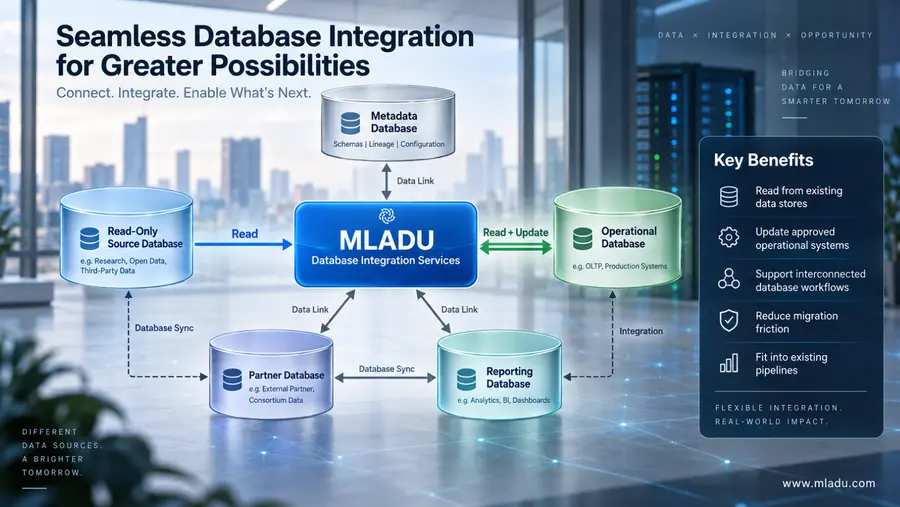
What Is Integration by Database?
Integration by database is a pattern in which one system communicates operational information to another through records stored in a database. An application may create or update a record to indicate that data is ready, that an action should begin, that a transfer has completed, or that a downstream process can proceed.
The database may act as a workflow handoff, a system of record, a coordination mechanism, or an operational status store. In some environments, this pattern has evolved over many years and is deeply embedded in application logic.
How MLADU Can Participate in a Database-Centered Workflow
A database integration can be designed so that MLADU-related activity fits into an existing application pattern rather than forcing the application to be rebuilt.
For example, a customer application may record that a dataset is ready for transfer. An integration component can use that state as part of the workflow that initiates or coordinates MLADU activity. After the transfer reaches an agreed state, another database update may make status available to the application or downstream users.
The specific implementation depends on database technology, security controls, network boundaries, data ownership, transaction requirements, and the supported interfaces available in the environment.
When Database Integration Is a Strong Pattern
Database integration may be valuable when:
- Existing applications already rely on database records to coordinate processing
- Operational teams use database state to determine what happens next
- A legacy transfer process reads work instructions from a database
- Downstream applications require transfer status in an existing data model
- The organization wants to minimize changes to a mature application
- A database provides a controlled handoff between separate security or application zones
This pattern can be especially useful for applications that continuously read and update data stores as part of batch processing, research pipelines, laboratory workflows, clinical operations, data management, or enterprise processing.
Avoid Reproducing Fragile Database Coupling
A database integration should be deliberate. Direct table coupling, undocumented stored procedures, shared credentials, and assumptions about record state can create long-term support problems.
Professional Services can help identify the minimum integration contract that is needed. That may include clear ownership of tables or views, defined status values, error handling, retry behavior, reconciliation rules, and monitoring expectations.
The objective is to preserve the useful database-driven pattern without carrying forward unnecessary technical debt.
Benefits of Professional Services for Database Integration
MLADU Professional Services can help with architecture review, dependency analysis, integration design, implementation support, security coordination, test planning, failure scenarios, launch preparation, and documentation.
This is useful because database integrations often cross multiple ownership boundaries. Application teams understand the business logic. Database teams understand the data platform. Security teams control access. Operations teams need support procedures. MLADU Professional Services can help connect these perspectives around the transfer workflow.
A Practical Path from Legacy Workflow to MLADU
Organizations do not need to treat a database-centered legacy workflow as a reason to postpone modernization.
By understanding where the database participates in transfer orchestration today, the organization can decide which interactions should remain, which should be improved, and where MLADU should become the new transfer execution layer. This can reduce the perceived size of the migration and allow the application to continue operating through a familiar integration pattern.
Frequently Asked Questions
What is database integration in a data transfer workflow?
It is an integration pattern where database records are used to communicate work, status, state, or workflow handoffs between systems.
Can MLADU integrate with applications that already depend on database workflows?
A customer-specific integration can be evaluated and designed to fit database-centered workflows, subject to the environment, security requirements, and available interfaces.
Why use database integration instead of replacing the application workflow?
It can reduce the amount of application change required by preserving an established coordination pattern while modernizing the data transfer layer.
What should be defined in a database integration?
Ownership, data model or interface, status values, security, error handling, retries, reconciliation, monitoring, and production support expectations should be clearly documented.
Let's get started
Request a call with MLADU Concierge to discuss your database-driven workflow. Bring the current architecture, key tables or status concepts, integration constraints, and desired future state. MLADU Professional Services can help determine a practical database integration approach for your environment.
Topics
ON THIS PAGE
ASK A QUESTION
Can't find what you're looking for? Our team is here to help.


Try MLADU Free
Experience the power of AI powered data transfers.

No credit card required