User Data Roles
Secure, Scalable Access Control for Enterprise Data Transfers
Data security is not just about encryption and authentication. It is also about ensuring the right people have the right level of access to the right information.
Organizations operating in biotechnology, pharmaceutical research, healthcare, life sciences, financial services, and regulated industries require strong controls over who can access, manage, and govern their data transfer operations.
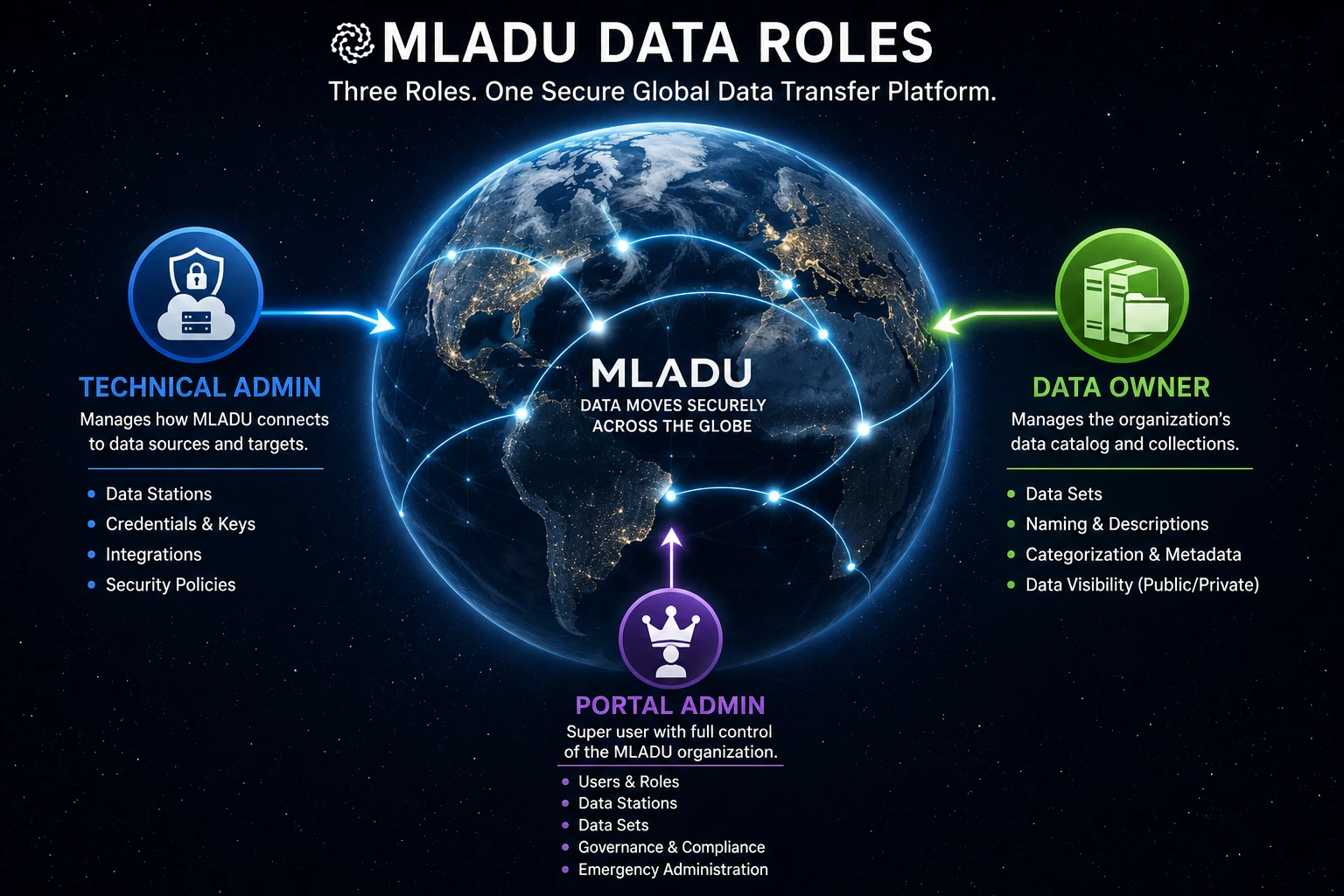
MLADU was designed with security and governance at its core. Through Role-Based Access Control (RBAC), organizations can assign responsibilities according to their security policies while maintaining separation of duties and operational accountability.
By clearly defining roles and permissions, MLADU helps organizations reduce risk, improve governance, and support compliance requirements while accelerating the movement of terabytes and petabytes of data.
How Does MLADU Control Access to Data?
MLADU takes data protection seriously.
Every MLADU organization is built around a Role-Based Access Control (RBAC) framework that allows administrators to assign permissions according to organizational policies, operational responsibilities, and security requirements.
MLADU provides more than eight distinct user roles, each designed to support specific functions within the platform.
While many roles focus on operational activities such as creating transfers, monitoring activity, or viewing reports, only three roles have the authority to directly manage how MLADU interacts with data:
- Technical Admin
- Data Owner
- Portal Admin
Each role serves a unique purpose and scope of responsibility.
This separation of duties aligns with industry best practices by ensuring that no single user must manage every aspect of the data transfer ecosystem unless explicitly authorized.
Organizations can assign as many or as few users to these roles as required by their internal security posture, governance requirements, and operational structure.
What Is the Technical Admin Role?
The Technical Admin role is responsible for managing MLADU's technical configuration and secure connectivity.
This role controls the technical integrations that allow MLADU to connect to data sources and data targets for data transfers.
In larger organizations, Technical Admin responsibilities often align with:
- Infrastructure teams
- Cloud operations teams
- DevOps teams
- Platform engineering teams
- Technical support teams
- Security operations teams
Technical Admin Responsibilities
Technical Admins manage:
- Data Station connectivity
- Access credentials
- Authentication keys
- Encryption configurations
- Integration endpoints
- Connection policies
- User security configurations
- Platform security settings
Within the context of data operations, Technical Admins are responsible for maintaining secure access to connected environments and ensuring credentials are updated according to established security procedures.
For example, if an AWS access key is rotated or an Azure credential expires, the Technical Admin updates the associated Data Station configuration to maintain secure connectivity.
Complete Audit Visibility
Every technical modification performed by a Technical Admin is captured within the MLADU audit log.
Organizations can review:
- Who performed a change
- What was changed
- When the change occurred
This supports compliance initiatives and provides operational transparency across the organization.
Scalable Administrative Control
The number of Technical Admin users available to an organization depends on:
- The selected MLADU subscription plan
- Optional purchases of additional Technical Admin licenses
This allows organizations to scale administrative capacity according to operational and security requirements.
What Is the Data Owner Role?
While Technical Admins manage how MLADU connects to data, Data Owners manage the data itself.
The Data Owner role is responsible for managing the organization's catalog of data collections, known within MLADU as Data Sets.
Think of the Data Owner as a data steward, curator, or chief librarian responsible for ensuring that data collections are accurately described and easily discoverable.
Data Owner Responsibilities
Data Owners manage:
- Data Set names
- Data Set descriptions
- Data Set categorization
- Data Set metadata
- Data Set visibility settings
- Data catalog organization
This role helps ensure users can quickly identify and select the correct data collection without needing to understand the technical details of the underlying storage environment.
Managing Public and Private Data Sets
Data Owners also control whether a Data Set is designated as public or private.
A Data Set can only be made public if the associated Data Station is also publicly available.
Within MLADU, public does not mean publicly accessible on the internet.
Instead, public visibility refers only to other organizations operating within the MLADU ecosystem.
When a Data Set is made public:
- Other MLADU organizations can discover it
- The Data Set ID becomes visible
- The Data Set name becomes visible
- The Data Set description becomes visible
Technical connection details remain protected and inaccessible.
This capability is especially useful for:
- Contract Research Organizations (CROs)
- Research consortiums
- Commercial data providers
- Scientific collaborations
- Data sharing initiatives
Why Separation of Duties Matters
Separating technical connectivity management from data catalog management is a critical security and governance principle.
Technical Admins manage access.
Data Owners manage meaning.
This separation reduces risk while ensuring that the people closest to the data are responsible for defining and organizing it.
Flexible Scaling
The number of Data Owners available to an organization is determined by:
- The selected MLADU subscription plan
- Optional purchases of additional Data Owner licenses
Organizations can scale this role to support growing data catalogs and expanding governance requirements.
What Is the Portal Admin Role?
The Portal Admin is the highest-privileged role within a MLADU organization.
Often referred to as the account super user, the Portal Admin possesses complete authority across the platform.
Portal Admin Responsibilities
Portal Admins can perform all functions available to:
- Technical Admins
- Data Owners
- Standard operational users
This includes managing:
- User accounts
- Security configurations
- Data Stations
- Data Sets
- Transfers
- Organizational settings
- Audit reviews
Emergency Access and Business Continuity
The Portal Admin role is particularly important during situations where designated administrators may be unavailable.
Examples include:
- Staff vacations
- Organizational transitions
- Emergency response activities
- Security incidents
- Disaster recovery scenarios
By maintaining a limited number of highly trusted Portal Admins, organizations ensure operational continuity without compromising security.
Enterprise-Level Governance
Most organizations intentionally limit the number of Portal Admins to reduce risk while maintaining sufficient administrative coverage.
As with other administrative roles, the number of Portal Admin users is determined by:
- The selected MLADU subscription plan
- Optional purchases of additional Portal Admin licenses
This allows organizations to align administrative authority with their governance model.
Why MLADU's Role-Based Security Model Matters
Modern organizations require more than simple user permissions.
They need a governance framework that separates responsibilities, supports compliance, and reduces operational risk.
MLADU accomplishes this through a role-based security architecture that clearly distinguishes between:
- Technical connectivity management
- Data catalog management
- Organizational administration
By assigning responsibilities to the appropriate users, organizations can strengthen security while enabling efficient collaboration and data movement.
Whether transferring research data, clinical trial results, genomic datasets, AI training data, or enterprise business information, MLADU provides the controls necessary to manage data transfers with confidence.
Secure Data Transfers Start with Strong Governance
MLADU Data Roles help organizations establish a secure and scalable foundation for enterprise data movement.
Through clearly defined responsibilities, comprehensive audit logging, and flexible administrative controls, MLADU enables organizations to protect sensitive information while maintaining operational efficiency.
Whether your organization requires strict separation of duties, collaborative data governance, or enterprise-scale administrative control, MLADU provides the tools needed to support your security strategy.
Start Your Free Trial Today
Ready to see how MLADU combines security, governance, and high-performance data transfers?
Start a free MLADU trial and explore how Role-Based Access Control, Data Stations, and Data Sets work together to simplify the transfer of terabytes and petabytes of data.
Prefer a personalized walkthrough?
Schedule a MLADU demonstration and discover how organizations are using MLADU to strengthen security, streamline operations, and accelerate data movement across teams, partners, and cloud platforms.
Topics
ON THIS PAGE
ASK A QUESTION
Can't find what you're looking for? Our team is here to help.


Try MLADU Free
Experience the power of AI powered data transfers.

No credit card required