Built for Research Collaboration
Research collaboration depends on data movement. Clinical research networks, rare disease consortia, biopharma partners, biotech teams, academic medical centers, and research institutions all need to securely share, exchange, and manage data across organizations, platforms, and regions.
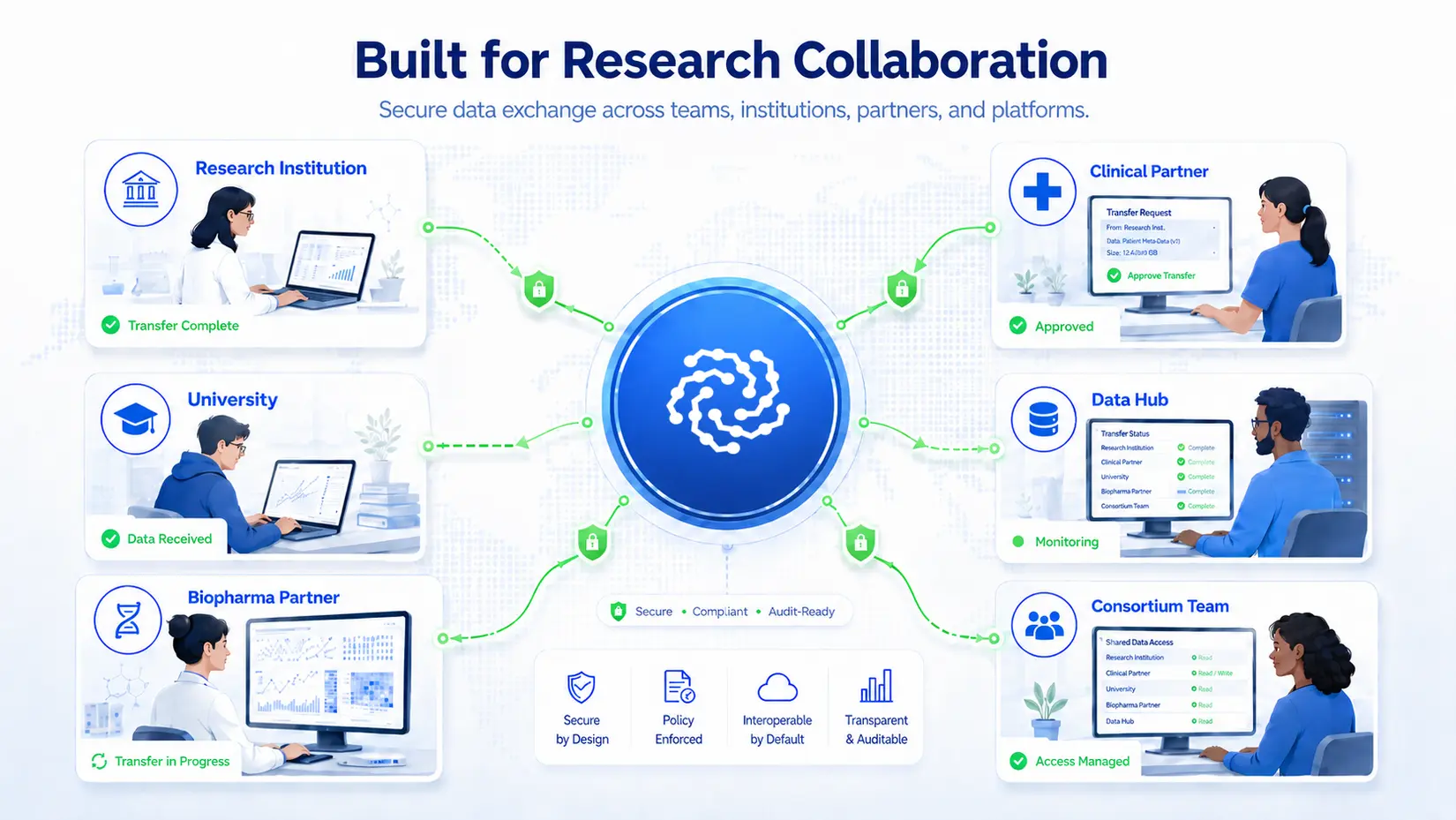
MLADU was built for that reality.
MLADU helps research organizations move critical data across cloud, consortium, and partner environments with security, visibility, governance, and scalability. Instead of treating each transfer as a one-time technical challenge, MLADU gives research teams a repeatable way to support ongoing collaboration.
Whether your organization is sharing clinical data, genomic files, imaging outputs, operational data, research archives, partner-submitted data sets, or multi-institutional study files, MLADU helps make data collaboration more reliable, auditable, and easier to manage.
Purpose-Built for the Way Research Gets Done
Research rarely happens inside one system, one institution, or one geographic location. It happens across universities, hospitals, data coordinating centers, laboratories, patient registries, biopharma sponsors, biotech partners, and consortium members.
That creates a common challenge: research data needs to move securely between many different environments.
MLADU is designed for research institutions, consortia, and data stewards who need secure, scalable, and efficient data transfer across teams, organizations, and borders.
With MLADU, organizations can support research collaboration without relying on fragile scripts, disconnected manual processes, oversized email attachments, consumer file sharing workarounds, or one-off transfer methods that are difficult to govern.
Built for Consortia
Consortia often require sustained data exchange between many participating organizations. Each member may have different systems, security requirements, cloud platforms, storage locations, access policies, and operational workflows.
MLADU helps support multi-institutional studies and distributed research teams by giving organizations a structured way to move data between trusted parties.
This is especially useful for:
- Rare disease research networks
- Clinical research consortia
- Data coordinating centers
- Academic medical center collaborations
- Multi-site research studies
- Biopharma and biotech partnerships
- Registry and cohort-based research
- External partner data submissions
MLADU helps participating organizations focus on research progress instead of repeatedly solving the mechanics of large data movement.
Governance Made Simple
Research data sharing requires more than the ability to move files. Teams also need governance, control, accountability, and visibility.
MLADU supports governance through role-based access, data transfer approvals, audit trails, user activity visibility, and controlled data movement workflows.
This helps organizations answer important governance questions such as:
- Who can access a data station?
- Who can request a transfer?
- Who can approve a transfer?
- What data was moved?
- When did the transfer occur?
- Which source and destination were involved?
- What activity was recorded during the transfer lifecycle?
- How can the transfer be reviewed later?
For consortia and research organizations, these questions matter because data sharing must be trusted, repeatable, and reviewable.
Global by Design
Modern research collaboration often crosses regions, institutions, cloud providers, and partner environments. A research organization may need to move data from a clinical partner in one region to a data hub in another. A university may need to submit research files to a coordinating center. A biopharma partner may need to receive large data sets from multiple external collaborators.
MLADU supports global research collaboration by helping organizations move data across distributed environments while maintaining visibility and control.
This is valuable for organizations that need to collaborate across:
- Research institutions
- Clinical partners
- Universities
- Data hubs
- Biopharma organizations
- Biotechnology companies
- Contract research partners
- Cloud and non-cloud data environments
MLADU helps reduce transfer friction so teams can collaborate more effectively regardless of where their data lives.
Seamless Integration With Research Workflows
Research data often lives across many platforms. Some data is stored in cloud environments. Some remain in secure file systems. Some is shared through Box, Dropbox, SFTP, FTPS, AWS S3, Azure Blob Storage, or partner-managed repositories.
MLADU helps organizations connect with the platforms and transfer patterns they already use.
Common MLADU data transfer patterns include:
- AWS S3
- Azure Blob Storage
- Box
- Dropbox
- SFTP
- FTPS
- Research data stations
- Partner data environments
This flexibility helps research teams avoid forcing every collaborator into the same platform before data movement can begin.
Instead, MLADU helps organizations create a secure bridge between the environments that already support their research operations.
Scalable for Growth
Research data volumes continue to grow. Genomic data, imaging studies, clinical research exports, operational data, machine learning data sets, and large analytical outputs can quickly become difficult to move with traditional file transfer approaches.
MLADU is designed to support larger data sets, more users, more collaborators, and more complex transfer workflows over time.
As collaboration expands, MLADU helps organizations support:
- Larger files
- Larger transfer jobs
- More transfer participants
- More data stations
- More data sets
- More internal and external users
- More complex source and destination patterns
- More frequent partner data exchange
This makes MLADU a stronger long-term fit for research organizations that need a repeatable data transfer strategy rather than a temporary workaround.
Trusted by Data Leaders
Data leaders need confidence that important research data can move securely, reliably, and with full visibility.
MLADU is built for teams that value security, collaboration, auditability, and operational control. It helps research data leaders create a more dependable data movement process for internal teams and external partners.
MLADU helps data leaders:
- Reduce failed transfer risk
- Improve transfer visibility
- Support audit readiness
- Improve collaboration with external partners
- Reduce manual coordination
- Standardize recurring transfer workflows
- Support data sharing across cloud and non-cloud platforms
- Improve confidence in large-scale research data movement
For organizations that depend on ongoing research collaboration, MLADU provides a better foundation for secure data exchange.
We Understand Research
Research collaboration is not just a technology problem. It is an operational, governance, security, and partnership challenge.
MLADU is informed by real-world research requirements and built to help organizations move critical data securely, efficiently, and in alignment with their mission.
Research teams need more than file movement. They need a platform that helps them collaborate with confidence.
MLADU supports that mission by combining:
- Secure data transfer
- Transfer visibility
- Role-based access
- Transfer approvals
- Audit trails
- Support for large data sets
- Cloud and non-cloud transfer patterns
- A workflow that supports distributed research teams
Better Data Collaboration Starts With Better Data Movement
When research data movement is slow, unclear, or unreliable, collaboration suffers. Teams lose time waiting for files, troubleshooting failed transfers, confirming whether data moved, and manually documenting activity.
MLADU helps research organizations create a better experience.
By using MLADU, organizations can make data collaboration:
- More secure
- More visible
- More scalable
- More repeatable
- More auditable
- Easier to govern
- Better aligned with research workflows
This helps teams spend less time managing transfer complexity and more time advancing research.
Who Benefits From MLADU Research Collaboration Workflows?
MLADU is especially useful for organizations that regularly share data with internal teams, external partners, research networks, or consortium members.
Common users and stakeholders include:
- Research data leaders
- Consortium administrators
- Data coordinating centers
- Principal investigators
- Clinical research operations teams
- Bioinformatics teams
- Data stewards
- Information security teams
- Compliance teams
- Cloud platform teams
- Biopharma research teams
- Biotech data teams
- Academic medical center IT teams
Each group benefits from a more structured, visible, and reliable way to move research data.
Create a Repeatable Collaboration Strategy
One of the biggest advantages of MLADU is that it helps organizations move beyond one-off transfer workarounds.
Instead of starting from scratch each time a partner needs to submit data or a research team needs to exchange files, MLADU helps organizations create a repeatable data transfer strategy.
That strategy can support recurring needs such as:
- Monthly partner data submissions
- Multi-site research study transfers
- Clinical research data exchange
- Data hub ingestion workflows
- Cloud-to-cloud data movement
- Box or Dropbox to cloud transfer workflows
- Secure SFTP or FTPS partner submissions
- Large-scale research archive movement
- Biopharma and biotech partner exchange
This repeatability is especially valuable for consortia and research organizations that need sustained collaboration over time.
Explore Related MLADU Documentation
To learn more about how MLADU supports research collaboration, explore these related topics:
- Data Transfer Patterns
- Data Stations
- Data Sets
- Data Transfer Approvals
- Data User Roles
- MLADU Data Security Model
- AWS S3 Transfers
- Azure Storage Transfers
- Box Folder Transfers
- Dropbox Transfers
- SFTP Transfers
- FTPS Transfers
- Why Concierge?
- MLADU Supports RDCRN Data Sharing Objectives
- MLADU Supports FAIR Data Principles
Start Building Better Data Collaboration
MLADU helps research organizations, consortia, biopharma teams, biotech companies, and data leaders securely exchange large research data sets across cloud, partner, and consortium environments.
If your team needs a better way to collaborate, share, and transfer research data, MLADU can help.
Try MLADU Free or schedule a demo to see how MLADU supports secure research collaboration at scale.
Topics
ON THIS PAGE
ASK A QUESTION
Can't find what you're looking for? Our team is here to help.


Try MLADU Free
Experience the power of AI powered data transfers.

No credit card required