MLADU Custom Integration Services
A modern data transfer platform should improve the way data moves without forcing every surrounding system to be redesigned. MLADU Custom Integration Services help organizations connect MLADU with the applications, data stores, messaging systems, operational tools, and automation patterns they already depend on.
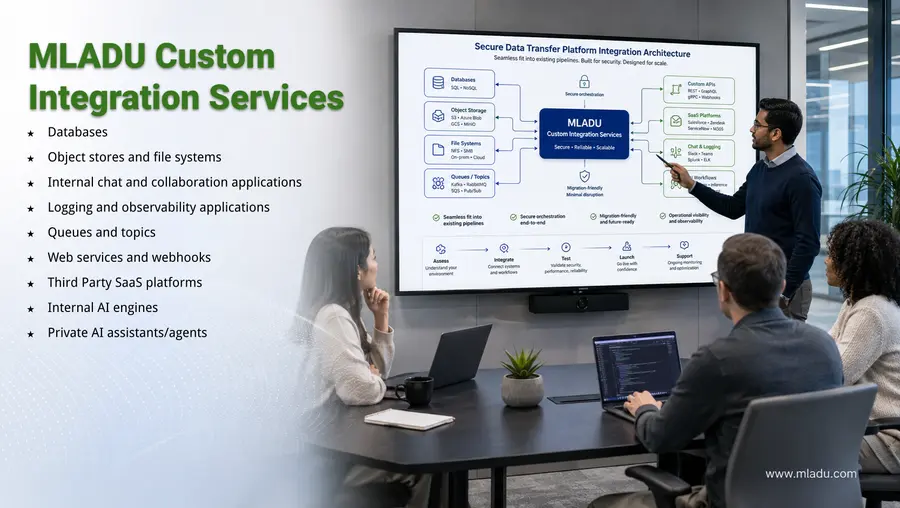
Make MLADU Fit the Existing Enterprise
Organizations rarely operate data transfer as an isolated function. Transfers may begin because a database record changes, a file appears in a directory, an object lands in cloud storage, an application calls a web service, a message is written to a queue, or a business user initiates an action in a SaaS platform.
The transfer may also need to update other systems after completion. Downstream applications may require status, logging, notifications, reconciliation information, workflow messages, or access to transfer results.
Custom Integration Services are intended to connect MLADU to these surrounding processes so the organization can modernize data movement without unnecessarily disrupting the systems that already work.
What Custom Integration Services Can Address
A custom integration engagement can begin with the current-state workflow and identify where MLADU should participate. The integration may be simple and targeted or may span several enterprise systems.
Common patterns include:
- Database-driven integration
- Object store and file system integration
- Internal chat and collaboration integration
- Logging and observability integration
- Queue and topic integration
- Web service and webhook integration
- Custom SaaS integration
- Internal AI engine and private AI assistant integration
The exact design depends on the customer environment, security requirements, supported interfaces, operational constraints, and desired outcome.
Preserve the Pipeline, Improve the Transfer Layer
One of the largest adoption concerns is the belief that a new data transfer platform requires replacing the full data pipeline. Often, that is not necessary.
A custom integration can allow upstream applications to continue producing data in familiar ways while MLADU becomes responsible for governed movement between approved locations. Downstream systems can continue receiving the events, records, files, or notifications they require.
This reduces the size of the change. Instead of rebuilding the business process around the transfer platform, the integration can adapt the transfer platform to the business process.
Use Integration Work to Address Current-State Problems
Custom integration is also an opportunity to improve problems that already exist.
For example, a current process may depend on polling a shared folder every few minutes, parsing email messages, maintaining credentials in scripts, copying status into a spreadsheet, or manually notifying a downstream team when a transfer completes.
Professional Services can evaluate these steps and determine whether a cleaner integration pattern can reduce fragility, duplicated effort, or unnecessary manual work. The goal is not simply to reproduce every current-state behavior. The goal is to preserve what is valuable while improving the parts that create cost, delay, risk, or support burden.
Benefits of Using MLADU Professional Services for Integration
Using MLADU Professional Services for custom integration can provide several advantages:
- Direct knowledge of MLADU concepts, capabilities, and operating patterns
- A design that considers transfer behavior and the surrounding enterprise workflow together
- Reduced time spent by internal teams learning platform-specific implementation details
- Coordinated testing across MLADU and customer-owned systems
- Documentation of the new integration pattern
- Support for launch planning and production transition
- A clearer path for troubleshooting ownership after go-live
The engagement can also be coordinated with migration services when the integration is part of replacing a legacy transfer platform.
Integration Is an Engineering Decision, Not a Marketing Assumption
Not every requested integration should be implemented in the same way. The best pattern depends on data volume, latency, security boundaries, platform capabilities, failure handling, audit requirements, and ownership.
Professional Services can help evaluate those tradeoffs before implementation begins. That is especially important in regulated, research, healthcare, life sciences, financial, and enterprise environments where an integration must be supportable and explainable after launch.
Frequently Asked Questions
What are MLADU Custom Integration Services?
They are Professional Services engagements that help design, build, test, document, and launch customer-specific integrations between MLADU and existing enterprise systems or workflows.
Does adopting MLADU require rebuilding an existing data pipeline?
Not necessarily. A custom integration can often preserve upstream and downstream processes while introducing MLADU as the governed data movement layer.
What types of systems can be considered for custom integration?
Potential patterns include databases, file systems, object stores, queues, topics, APIs, webhooks, chat and logging platforms, SaaS applications, and internal AI systems. Feasibility depends on the customer environment and available interfaces.
Can custom integration services be combined with migration services?
Yes. Integration and migration work can be coordinated when new integration points are part of replacing or reducing reliance on a legacy transfer platform.
Let's get started
If MLADU appears to be a strong fit but you are unsure how it would connect to your current applications or data pipelines, request a call with MLADU Concierge. We can discuss your existing integration points and identify practical options for fitting MLADU into the environment you already operate.
Topics
ON THIS PAGE
ASK A QUESTION
Can't find what you're looking for? Our team is here to help.


Try MLADU Free
Experience the power of AI powered data transfers.

No credit card required