MLADU Custom AI Integration
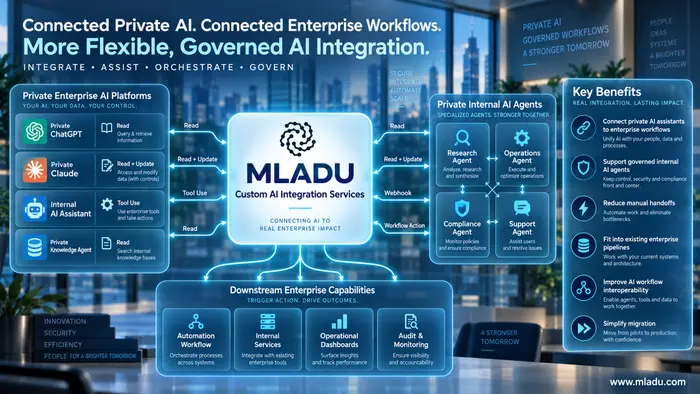
AI systems are becoming active participants in enterprise and research workflows. They summarize operational information, assist analysts, coordinate tasks, prepare data, trigger tools, and help users interact with complex systems. MLADU Professional Services can help organizations evaluate custom integrations between MLADU-related workflows and internal AI engines or private enterprise AI implementations.
What Is Custom AI Integration?
Custom AI integration connects an approved AI system with a defined part of the data transfer workflow.
The AI system might help users discover transfer information, prepare requests, interpret status, coordinate workflow steps, or invoke approved tools through a controlled interface. In other cases, an AI-enabled pipeline may produce or consume datasets that MLADU moves between approved locations.
The integration should be designed around explicit permissions and deterministic system controls. AI can assist the workflow, but transfer security, authorization, data handling, and operational policy should remain governed by the systems responsible for those functions.
Internal AI Engines and Private Enterprise Assistants
Organizations may operate internal AI platforms, private large language model services, or enterprise deployments of products such as ChatGPT or Claude.
These environments may be configured with enterprise identity, private data controls, approved connectors, internal tools, retrieval systems, or agentic workflows. A custom integration can evaluate how an approved AI experience should interact with MLADU-related functions without exposing credentials or sensitive transfer data beyond authorized boundaries.
How AI Can Participate in Data Transfer Workflows
Potential patterns may include:
- Helping users prepare a transfer request from natural-language instructions
- Retrieving approved operational status for a user who is authorized to see it
- Summarizing transfer activity for an operations team
- Assisting with exception triage using non-sensitive diagnostic information
- Coordinating a workflow in which an AI agent calls approved internal tools
- Moving datasets produced by AI, analytics, or model-training pipelines
- Making completed datasets available to an authorized downstream AI environment
The appropriate pattern depends on the AI platform, MLADU capabilities, data classification, permissions, security architecture, and organizational AI policy.
AI Integration Requires Strong Guardrails
AI integrations deserve additional design scrutiny because conversational interfaces can make complex actions feel deceptively simple.
Professional Services can help define boundaries around what the AI can request, what it can read, what it can never access, when human approval is required, what actions must be deterministic, and how activity is logged.
The integration should also consider prompt injection, tool authorization, secret handling, data leakage, retention, model-provider controls, hallucinated parameters, and the possibility that an AI system may produce an incorrect interpretation of operational state.
When Custom AI Integration May Be Valuable
This pattern may be useful when:
- The organization has an established internal AI platform
- Teams already use private ChatGPT, Claude, or another governed enterprise assistant
- AI agents participate in internal workflows through approved tools
- Data transfer is a frequent step in AI or analytics pipelines
- Users need a simpler interface for transfer-related information
- Operations teams want AI-assisted summaries or triage
- Large datasets must move into or out of controlled AI environments
The objective is not to add AI simply because it is available. The objective is to improve the workflow while maintaining clear operational control.
Benefits of MLADU Professional Services for AI Integration
Professional Services can help bring together data transfer expertise, customer AI architecture, security requirements, governance expectations, and production operations.
An engagement can include use-case definition, threat and boundary review, interface design, approved tool design, testing, failure scenarios, human approval points, audit requirements, launch planning, and documentation.
Frequently Asked Questions
What is MLADU custom AI integration?
It is a Professional Services engagement that evaluates and implements approved connections between MLADU-related workflows and internal AI engines, private enterprise assistants, or AI-enabled pipelines.
Can MLADU be integrated with private ChatGPT or Claude environments?
A customer-specific integration can be evaluated for private or enterprise AI environments when appropriate interfaces, permissions, security controls, and governance requirements are available.
What risks should an AI integration consider?
Key considerations include authorization, data leakage, prompt injection, secret handling, incorrect AI outputs, tool permissions, human approval, logging, retention, and deterministic control of sensitive actions.
Should AI directly control every data transfer action?
No. The integration should define explicit boundaries. Sensitive actions may require deterministic controls, policy checks, and human approval rather than unconstrained AI execution.
Let's get started
Request a call with MLADU Concierge to discuss your internal AI environment, private enterprise assistant, or AI-enabled data pipeline. MLADU Professional Services can help evaluate whether a controlled integration can improve how your organization coordinates and uses data transfer workflows.
Topics
ON THIS PAGE
ASK A QUESTION
Can't find what you're looking for? Our team is here to help.

Try MLADU Free
Experience the power of AI powered data transfers.

No credit card required