Built to Move Research Data
How Organizations Move the Important Research Data
Research data is growing faster than traditional transfer tools were designed to support. Clinical research networks, rare disease consortiums, genomic programs, imaging teams, biopharma organizations, biotech companies, and multi-institutional research partners all need to move large, complex, and sensitive data across cloud, partner, and secure storage environments.
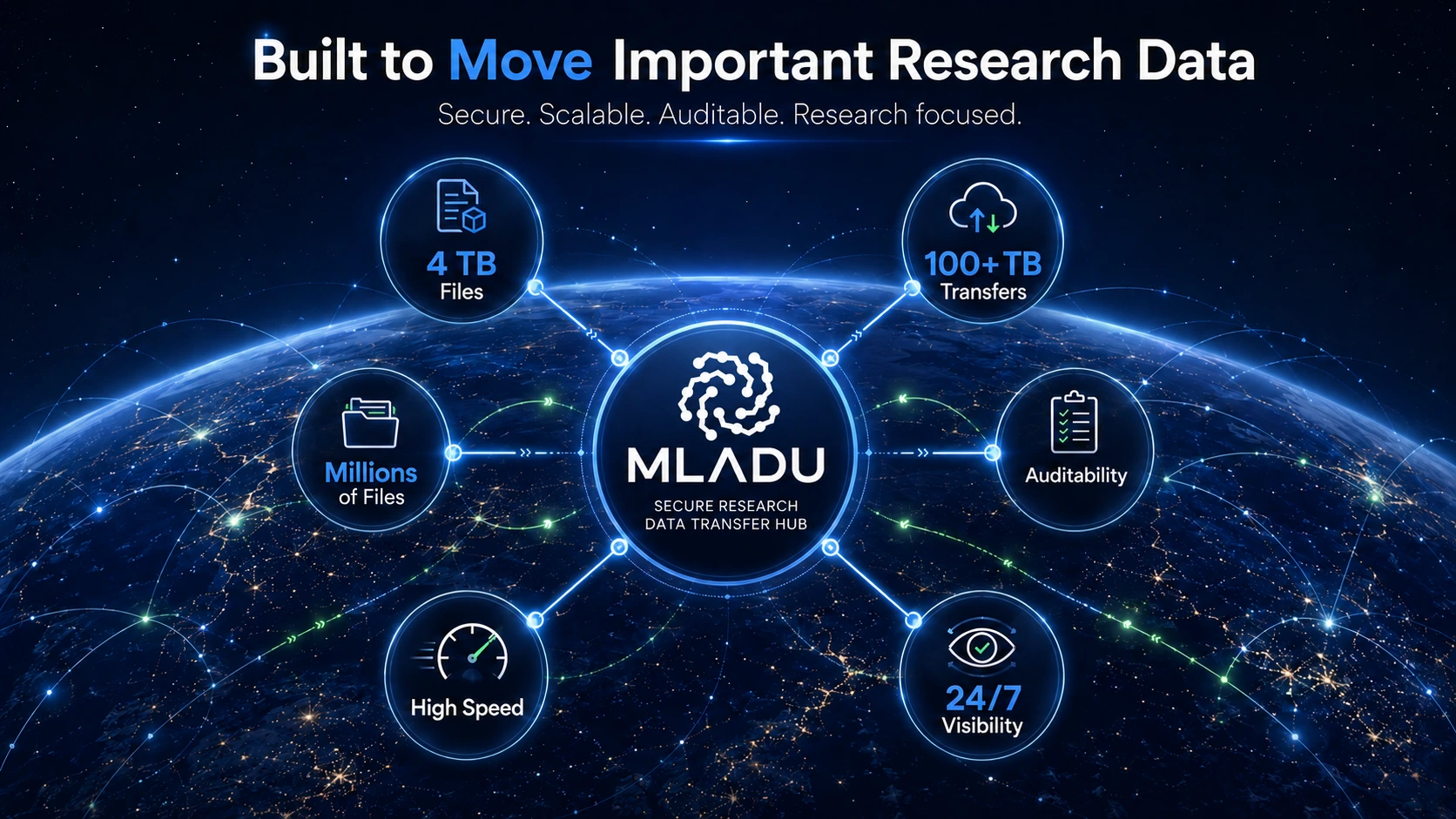
MLADU was built for that challenge.
MLADU helps organizations securely move large research data sets with speed, visibility, auditability, and expert support. Whether your team needs to transfer terabytes of clinical data, millions of research files, genomic outputs, imaging data, operational data, or partner-submitted data sets, MLADU provides a scalable data transfer platform designed for modern research collaboration.
Why Research Data Transfers Are Different
Research data movement is not the same as sending ordinary business files. Research transfers often involve large file sizes, complex directory structures, sensitive data, cross-organization workflows, and strict expectations for tracking, approvals, and compliance.
Research teams may need to move data between:
- AWS S3 buckets
- Azure Blob Storage containers
- Box folders
- Dropbox environments
- SFTP servers
- FTPS endpoints
- Consortium data hubs
- Partner research environments
- Clinical and operational data repositories
MLADU gives research organizations a purpose-built way to plan, execute, monitor, and document these transfers without relying on fragile scripts, manual handoffs, or disconnected tools.
MLADU by the Numbers
The MLADU platform is designed to support large-scale data movement for organizations that cannot afford uncertainty, poor visibility, or unreliable transfer workflows.
4 TB Maximum Individual File Size
Some research files are exceptionally large. Imaging files, genomic outputs, compressed archives, analytical exports, and other high-value research assets can exceed the limits of many common transfer approaches.
MLADU supports individual files up to 4 TB, helping organizations move large research files without forcing teams to split, compress, repackage, or manually reassemble data.
This is especially important for research programs that work with:
- Genomic data
- Clinical imaging
- Multi-omics data
- Large analytical exports
- High-volume research archives
- Partner-generated data sets
100+ TB Enterprise Transfers
Many research organizations do not move data in small batches. Consortium data sharing, clinical trial collaboration, biopharma research partnerships, and institutional data exchange can involve tens or hundreds of terabytes.
MLADU is designed to support 100+ TB transfer jobs, helping organizations move enterprise-scale research data with confidence.
This enables teams to support large research workflows such as:
- Moving data from Azure to AWS S3
- Consolidating data from multiple research partners
- Delivering data to a consortium data hub
- Transferring data from secure file systems to cloud storage
- Moving large data sets for analytics, AI, or downstream processing
Millions of Files Per Transfer
Research data sets are often not just large in total size. They can also include large file counts. A single data set may include hundreds or millions of small files, nested directories, logs, metadata, exports, images, configuration files, or supporting documents.
MLADU is designed for high-volume file movement where both scale and structure matter.
This helps research teams avoid common problems such as:
- Failed transfers due to excessive file counts
- Missing files after manual transfer attempts
- Directory structure errors
- Poor visibility into transfer progress
- Lack of clear audit history
- Inconsistent retry and validation behavior
100% Transfer Auditability
Research organizations need to know what happened, when it happened, and who was involved. Transfer visibility is not just a convenience. It is part of operational governance.
MLADU provides auditability across the transfer workflow, helping teams document activity, approvals, transfer events, and data movement history.
This is valuable for:
- Internal audits
- Consortium governance
- Data sharing reviews
- Compliance workflows
- Partner accountability
- Security reviews
- Operational troubleshooting
With MLADU, teams can better understand the full transfer lifecycle rather than relying on scattered emails, screenshots, scripts, or manual notes.
High Speed Optimized Performance
Large research transfers can delay critical work when they take too long to complete. Slow transfer performance can affect research timelines, downstream analytics, collaboration windows, and operational commitments.
MLADU is designed for optimized transfer performance across supported platforms and patterns. The goal is to help research teams move data faster while maintaining the governance, visibility, and security needed for sensitive research workflows.
MLADU helps organizations reduce friction when transferring data between cloud, partner, and secure storage environments.
24/7 Transfer Visibility
Research teams are often distributed across institutions, regions, time zones, and partner organizations. They need to know what is happening with their transfers even when teams are not sitting in the same office or working the same schedule.
MLADU provides 24/7 transfer visibility, allowing authorized users to monitor transfer status, approvals, audit history, and platform activity anytime.
This helps research teams answer important questions such as:
- Has the transfer started?
- Is the transfer still running?
- Was the transfer approved?
- Did the transfer complete?
- What activity occurred?
- Where can I find the audit history?
- What action is needed next?
Built for Research Collaboration
MLADU is built for organizations that share data across teams, institutions, partners, and platforms. This makes it a strong fit for research consortia, rare disease networks, academic medical centers, biopharma organizations, biotech companies, and research data leaders.
Research collaboration often requires more than a simple upload and download experience. It requires controlled access, reliable transfer execution, data movement visibility, and confidence that sensitive research data is being handled properly.
MLADU supports this by helping teams:
- Move large research data sets across environments
- Connect to popular research data platforms
- Support internal and external transfer workflows
- Maintain visibility into transfer activity
- Reduce operational bottlenecks
- Improve documentation and audit readiness
- Support governance across distributed collaborators
Designed for Cloud and Non-Cloud Research Platforms
Research data lives in many places. Some data is already in cloud storage. Some remains in secure file systems, data stations, SFTP servers, FTPS endpoints, Box folders, Dropbox environments, or partner-managed systems.
MLADU supports multiple data stations and transfer patterns so organizations can move data across the environments they already use.
Supported and commonly requested patterns include:
- AWS S3
- Azure Blob Storage
- Box
- Dropbox
- SFTP
- FTPS
- Research data stations
- Partner data environments
This flexibility helps research teams avoid the need to force every partner or institution into the same storage platform before a transfer can begin.
Why MLADU Matters for Research Buyers
MLADU is designed for organizations that need a repeatable, scalable data transfer strategy. Instead of approaching every large transfer as a one-time emergency, MLADU gives research teams a platform for ongoing data movement.
For consortium and research buyers, this matters because data sharing is not a one-time task. It is a recurring operational need.
MLADU helps research organizations:
- Reduce transfer delays
- Improve visibility
- Support larger data sets
- Increase confidence in transfer completion
- Strengthen audit readiness
- Support multi-institution collaboration
- Simplify data movement across platforms
- Create a repeatable transfer process
A Better Way to Move Critical Research Data
MLADU was built for research organizations that need to move important data without sacrificing security, speed, visibility, or control.
Whether your organization is moving clinical data, genomic data, imaging data, operational data, partner-submitted data, or large research archives, MLADU provides a platform designed to support modern research data movement at scale.
If your team is struggling with large file transfers, failed transfers, limited visibility, complex approval workflows, or fragmented data sharing processes, MLADU can help you create a more reliable path forward.
Explore More MLADU Documentation
To learn more about how MLADU supports secure research data transfers, explore these related topics:
- Data Transfer Patterns
- AWS S3 Transfers
- Azure Storage Transfers
- Box Folder Transfers
- Dropbox Transfers
- SFTP Transfers
- FTPS Transfers
- Data Transfer Approvals
- MLADU Data Security Model
- Data Stations
- Data Sets
- Monthly Rollover
- Transfer Thresholds
- Why Concierge?
Start Moving Research Data Faster
MLADU helps research organizations move large, sensitive, and complex data sets across cloud, consortium, and partner environments.
Try MLADU Free or schedule a demo to see how MLADU can help your organization move research data faster with visibility, auditability, and confidence.
Topics
ON THIS PAGE
ASK A QUESTION
Can't find what you're looking for? Our team is here to help.


Try MLADU Free
Experience the power of AI powered data transfers.

No credit card required