MLADU Internal Queues and Topics Integration
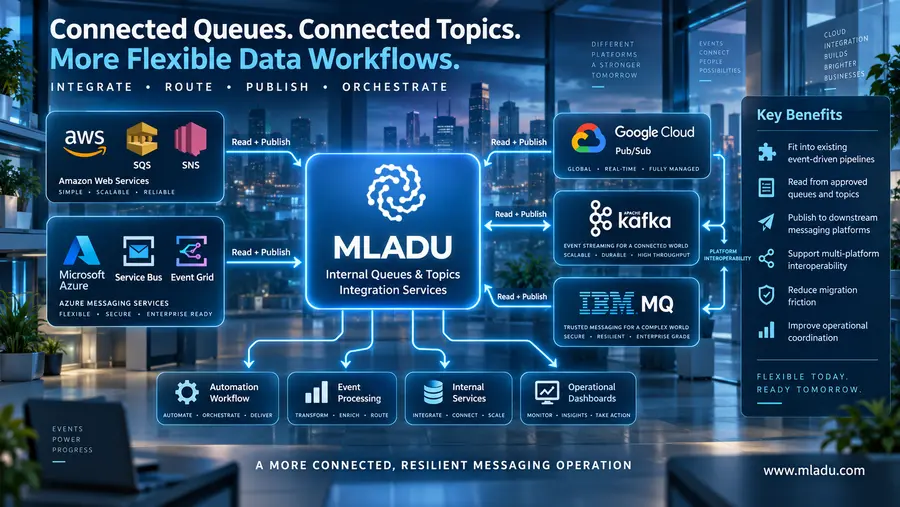
Enterprise applications increasingly coordinate work through messaging rather than direct system-to-system calls. Queues and topics can decouple applications, absorb bursts of work, and allow producers and consumers to operate independently. MLADU Professional Services can help organizations connect transfer workflows to these event-driven patterns.
What Is Integration by Queue?
A queue is a messaging pattern in which producers place messages into a managed channel and consumers retrieve those messages for processing. A message is generally handled by one consumer or one logical processing path.
Queues are useful when work must be processed asynchronously, when systems operate at different speeds, or when a workflow needs durable buffering between components.
What Is Integration by Topic?
A topic commonly supports publish-and-subscribe behavior. A producer publishes an event, and multiple subscribed consumers may receive that event according to the messaging platform's configuration.
Topics are useful when the same business event needs to inform several downstream systems, such as operations, analytics, notifications, audit processing, or additional workflow automation.
How MLADU Can Participate in Event-Driven Architectures
A queue or topic can be used as part of the integration contract around data movement. An upstream application might publish that a dataset is ready. An integration component can use the message to coordinate MLADU activity. After an agreed transfer state is reached, another event can communicate status to downstream consumers.
This approach can allow MLADU to participate in an existing architecture without requiring tightly coupled application calls. It can also preserve established enterprise patterns for retries, dead-letter handling, monitoring, and message ownership.
When Queue and Topic Integration Is a Strong Fit
This pattern may be valuable when:
- Applications already use messaging middleware for workflow orchestration
- Data processing is asynchronous
- Producers and consumers should remain loosely coupled
- Multiple downstream systems need to react to transfer completion
- Current transfer scripts are triggered by messages
- The organization wants to avoid synchronous dependencies
- Workload volume can vary significantly over time
Research pipelines, cloud-native applications, enterprise integration platforms, and data engineering systems often use these patterns to coordinate processing across many components.
Design for Idempotency, Retries, and Reconciliation
Messaging systems are powerful because they accept that distributed systems can fail. A strong transfer integration should therefore define what happens if a message is delivered twice, processed late, retried, or sent to a dead-letter path.
Professional Services can help define message schemas, correlation identifiers, idempotency rules, retry behavior, poison-message handling, ordering assumptions, reconciliation, monitoring, and security. These details reduce the risk that a messaging integration creates duplicate transfers or unclear workflow state.
Benefits of Professional Services for Messaging Integration
MLADU Professional Services can work with application, integration, cloud, security, and operations teams to document the current messaging pattern and design the MLADU interaction around it.
The result can reduce the amount of custom transfer-specific code maintained inside business applications while allowing the broader architecture to continue using familiar queue and topic patterns.
Frequently Asked Questions
What is queue integration?
Queue integration uses asynchronous messages placed into a managed queue to coordinate work between producers and consumers.
What is topic integration?
Topic integration commonly uses publish-and-subscribe messaging so multiple consumers can react to the same event.
Can queues or topics be used around MLADU transfer workflows?
A customer-specific integration can be designed to use messaging for transfer-related workflow events, subject to the environment, platform capabilities, and security requirements.
What should a queue or topic integration define?
It should define message schemas, ownership, correlation, idempotency, retries, error handling, dead-letter behavior, security, monitoring, and reconciliation.
Let's get started
Request a call with MLADU Concierge to discuss your current queue, topic, or event-driven architecture. MLADU Professional Services can help identify how transfer initiation, status, completion, and exception events can fit into the messaging patterns your organization already operates.
Topics
ON THIS PAGE
ASK A QUESTION
Can't find what you're looking for? Our team is here to help.


Try MLADU Free
Experience the power of AI powered data transfers.

No credit card required