Why Sharing Research Data Across Organizations Is Still So Difficult
Modern Research Depends on Collaboration
Very few scientific discoveries happen within the walls of a single organization anymore.
Today's research routinely spans:
- Universities
- Academic medical centers
- Children's hospitals
- Pharmaceutical companies
- Biotechnology organizations
- Government agencies
- Contract research organizations (CROs)
- International research consortiums
Whether studying rare diseases, developing precision medicine, or training artificial intelligence models, researchers depend on sharing data across organizational boundaries.
This collaborative approach has accelerated scientific discovery, expanded access to expertise, and improved patient outcomes.
However, it has also introduced one of modern research's greatest operational challenges:
How do organizations securely exchange massive amounts of research data while maintaining governance, security, and compliance?
The answer is far more complicated than simply sending files.
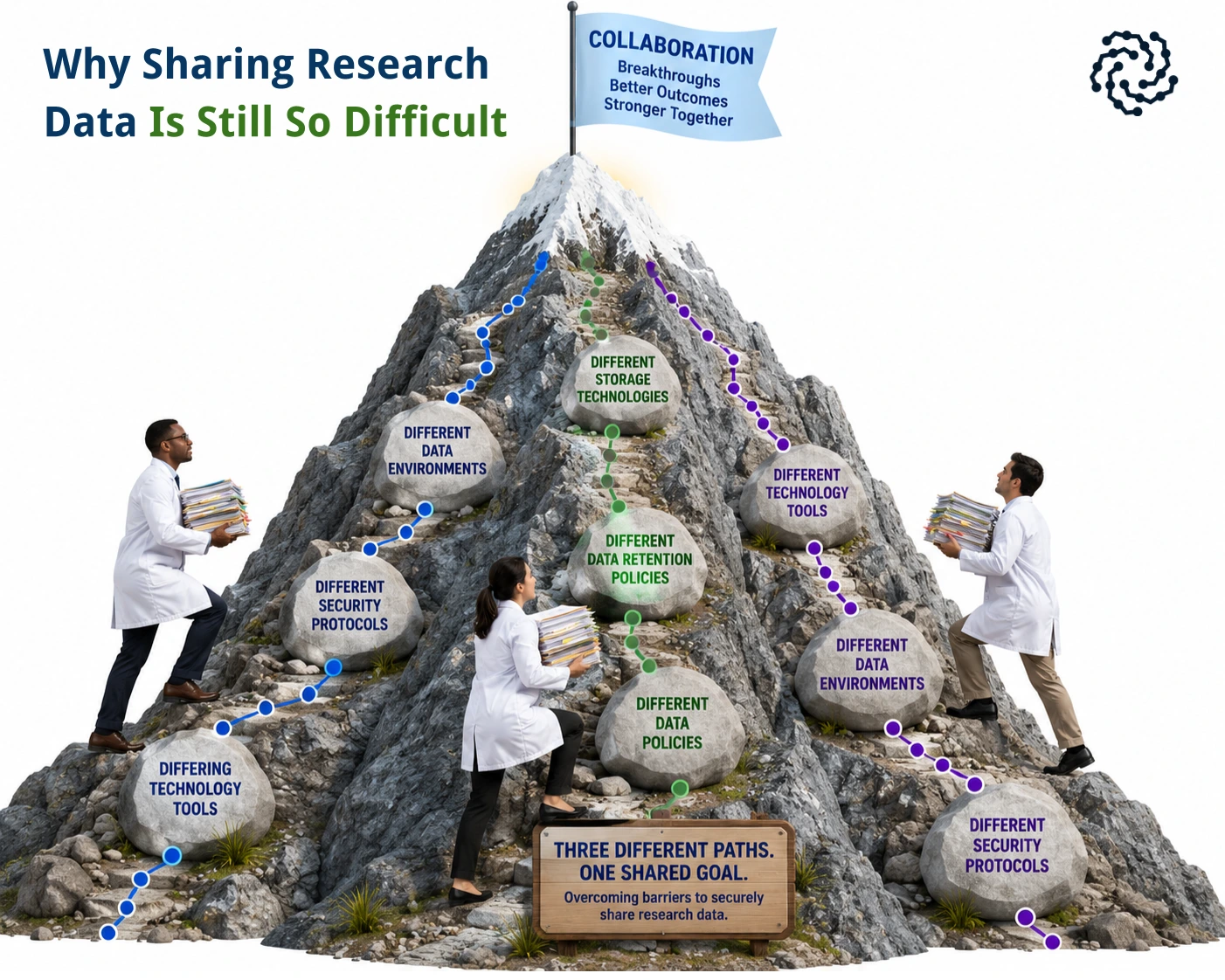
Every Organization Operates Differently
Every institution has its own technology environment.
One organization may store data in Amazon S3.
Another may use Microsoft Azure Blob Storage.
A third may rely on secure FTP servers.
Others may manage data through Box, Dropbox, institutional storage systems, or custom research portals.
Each environment introduces different:
- Authentication methods
- Security requirements
- Network configurations
- Identity management systems
- Access approval processes
- Data retention policies
Researchers frequently discover that moving the data is only a small part of the overall challenge.
Collaboration Creates Technical Complexity
Modern research data rarely moves between identical environments.
A single project may involve:
- Cloud-to-cloud transfers
- Cloud-to-on-premises transfers
- International collaborators
- Institutional firewalls
- Restricted research networks
- Multiple storage technologies
Each connection must be configured, secured, tested, and monitored.
The result is significant time spent coordinating infrastructure instead of advancing research.
The Volume of Data Has Changed Everything
Scientific datasets have grown dramatically.
Research organizations now routinely exchange:
- Whole genome sequencing data
- Multi-omics datasets
- Digital pathology images
- Medical imaging
- Clinical trial data
- AI training datasets
- Operational research data
Many projects involve:
- Hundreds of thousands of files
- Millions of files
- Individual files measuring multiple terabytes
- Overall transfers exceeding one hundred terabytes
Traditional file-sharing tools were never designed for this scale.
As datasets continue to grow, collaboration becomes increasingly difficult without specialized research data transfer infrastructure.
Every Collaboration Introduces New Governance Requirements
Technology is only one part of successful collaboration.
Each participating organization brings its own governance requirements.
Research teams must often coordinate:
- Data Use Agreements
- Data Transfer Agreements
- Institutional Review Board approvals
- Sponsor requirements
- Consortium policies
- Security reviews
- Privacy requirements
- Internal approval workflows
Organizations increasingly expect data sharing to be documented, auditable, and repeatable.
The emphasis has shifted from simply exchanging data to demonstrating responsible stewardship throughout the collaboration.
Organizations such as the National Institutes of Health (NIH) reinforce this through the NIH Data Management and Sharing Policy, which encourages researchers to plan for responsible data management and sharing from the beginning of a project.
FAIR Data Principles Raise the Bar
The research community has broadly embraced the FAIR Guiding Principles, encouraging scientific data to be:
- Findable
- Accessible
- Interoperable
- Reusable
These principles improve scientific reproducibility and collaboration while recognizing that access must be appropriate for the sensitivity of the data.
Implementing FAIR principles across multiple organizations often requires more than shared storage. It requires coordinated governance, standardized workflows, and technologies that support secure collaboration.
The FAIR Principles were first published in Scientific Data and continue to guide research organizations worldwide. FAIR Guiding Principles for Scientific Data Management and Stewardship
Collaboration Is Also About Trust
Successful research collaborations depend on confidence.
Researchers need confidence that:
- Data arrived successfully.
- Files were not corrupted.
- Only authorized collaborators received access.
- Transfer approvals were documented.
- Audit records were preserved.
- Sensitive research data remained protected.
Without that confidence, collaboration slows dramatically as organizations rely on manual processes, email confirmations, spreadsheets, and repeated verification.
Technology should reduce friction, not create more of it.
Why Consumer File-Sharing Tools Fall Short
Many organizations initially attempt to use general-purpose file-sharing services for research collaboration.
These tools work well for sharing presentations or office documents.
They are far less effective when handling:
- Hundreds of terabytes
- Millions of files
- Multi-site consortiums
- Long-running transfers
- Institutional governance requirements
- Complete audit histories
- Formal approval workflows
Research collaboration requires capabilities specifically designed for scientific data exchange rather than everyday business file sharing.
How MLADU Simplifies Cross-Organization Research Collaboration
MLADU was purpose-built to support secure research collaboration across organizations.
Instead of requiring every institution to build custom workflows, MLADU provides a consistent, governed platform for exchanging large research datasets.
MLADU supports secure transfers between:
- Amazon S3
- Microsoft Azure Blob Storage
- Box
- Dropbox
- SFTP
- FTPS
- Additional enterprise storage platforms
Researchers benefit from:
- High-volume data transfers
- Secure cloud-to-cloud collaboration
- Role-based permissions
- Transfer approval workflows
- Complete audit histories
- End-to-end transfer visibility
- Dedicated customer environments
- MLADU Concierge assistance for complex data exchange projects
By providing a common collaboration platform, MLADU reduces operational complexity while helping consortiums focus on research instead of infrastructure.
Collaboration Should Accelerate Discovery, Not Delay It
The future of biomedical research depends on collaboration.
As datasets continue to grow and research becomes increasingly distributed, organizations need more than storage capacity.
They need secure, governed, interoperable data exchange.
The institutions that simplify collaboration will accelerate discoveries, improve clinical trial readiness, strengthen partnerships, and deliver scientific advances to patients more quickly.
Sharing research data across organizations should not be the hardest part of research.
With the right platform, it becomes one of its greatest strengths.
References
To learn more about research collaboration, data sharing, and FAIR data principles, explore these trusted resources:
- National Institutes of Health (NIH)
- NIH Data Management & Sharing Policy
- NIH Office of Data Science Strategy
- FAIR Guiding Principles for Scientific Data Management and Stewardship (Nature Scientific Data)
- GO FAIR Initiative
- Research Data Alliance (RDA)
Topics
ON THIS PAGE
ASK A QUESTION
Can't find what you're looking for? Our team is here to help.


Try MLADU Free
Experience the power of AI powered data transfers.

No credit card required