MLADU Migration Post-Launch Services
A successful migration is not finished when the production launch window closes. MLADU Migration Post-Launch Services help organizations complete cleanup, stabilize operations, update documentation, verify legacy changes, transition ownership, and help users take fuller advantage of MLADU after the incubation period.
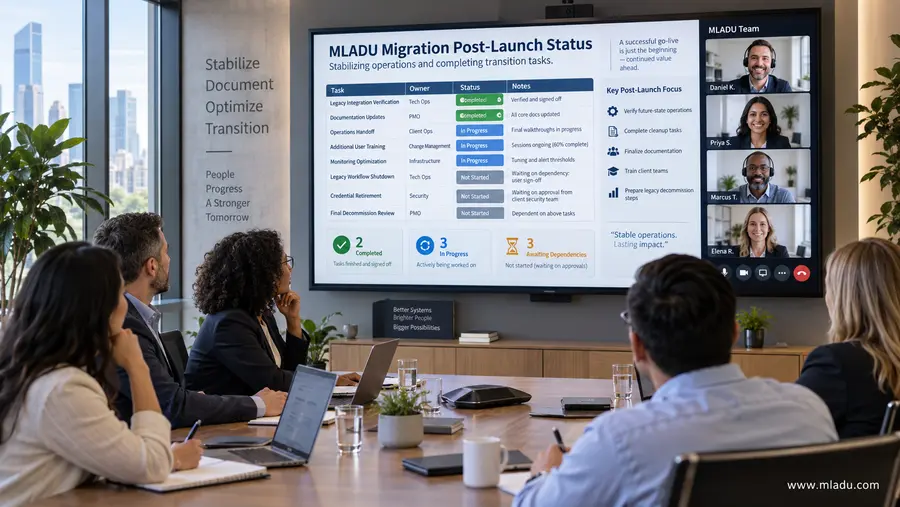
What Is Post Launch in a MLADU Migration?
Post launch is the set of activities performed after the agreed incubation period has concluded and the production implementation has demonstrated sufficient stability.
The focus shifts from intensive launch monitoring to completing the transition into normal operations. Project artifacts are finalized, temporary launch controls are removed or adjusted, legacy dependencies are verified, and the organization confirms that the future-state operating model is sustainable.
Complete the Technical Cleanup
Migration launch can leave temporary conditions that should not become permanent.
Examples may include diagnostic logging that was enabled only for launch, duplicate monitoring, temporary access, fallback integrations, legacy scheduled jobs, extra alerts, or parallel workflows kept in place as a safety measure.
Post-launch work reviews these items and determines what should remain, what should be removed, and what requires formal handoff to steady-state support.
Verify Former Integrations Are No Longer Active
When new integration points are successfully established and verified during launch, the organization may need to confirm that former integrations are no longer operational.
This can be important for cost, security, data integrity, and troubleshooting. A forgotten legacy process might continue copying data, writing duplicate messages, consuming credentials, or creating confusing operational evidence.
Post-launch verification helps ensure the new state is actually the state being operated.
Finalize Documentation
Architecture diagrams, operating procedures, support runbooks, integration specifications, security documentation, compliance process documentation, escalation paths, and ownership records should reflect the production implementation that was actually launched.
Documentation created before launch may require updates based on real production findings. Finalizing it after incubation helps ensure future operators are not forced to rely on outdated project assumptions.
Use Additional Training to Increase MLADU Value
The first training sessions before launch are often focused on the minimum information users need to go live safely.
After users gain real experience, additional training can be more effective. Teams now know which questions matter, which features can simplify their work, and where old habits are still shaping the new process.
Post-launch training can help clients more fully utilize MLADU capabilities and reduce the chance that a modern platform is used only to reproduce the limitations of the legacy process.
Transition from Project Support to Steady-State Operations
The post-launch phase should make support ownership clear.
Teams should know who owns MLADU administration, transfer operations, integrations, incidents, access requests, partner coordination, and escalation to Concierge. Open issues should have owners and target actions. Temporary project communications should transition to normal operational channels.
This helps prevent a successful technical launch from becoming an ambiguous long-term support model.
Frequently Asked Questions
What is MLADU migration post launch?
It is the phase after the incubation period that completes cleanup, documentation, ownership transition, legacy verification, training, and stabilization tasks.
Why verify former integrations after launch?
Legacy integrations may continue running unintentionally, creating duplicate data movement, cost, security exposure, or confusing operational results.
Can post-launch services include additional MLADU training?
Yes. Additional training can help users take advantage of MLADU features after they have gained real production experience.
What documentation should be finalized after migration?
Relevant architecture, integration, operating, support, security, compliance, escalation, and ownership documentation should be updated to reflect the actual production state.
Let's get started
Request a call with MLADU Concierge to discuss post-launch support. MLADU Professional Services can help complete migration cleanup, verify the future state, finalize documentation, provide additional training, and transition the implementation into sustainable normal operations.
Topics
ON THIS PAGE
ASK A QUESTION
Can't find what you're looking for? Our team is here to help.


Try MLADU Free
Experience the power of AI powered data transfers.

No credit card required