Secure Data Sharing Platform for Biotech Teams
How to Move Research Data Without Slowing Discovery
Biotechnology teams depend on data sharing at nearly every stage of research and development.
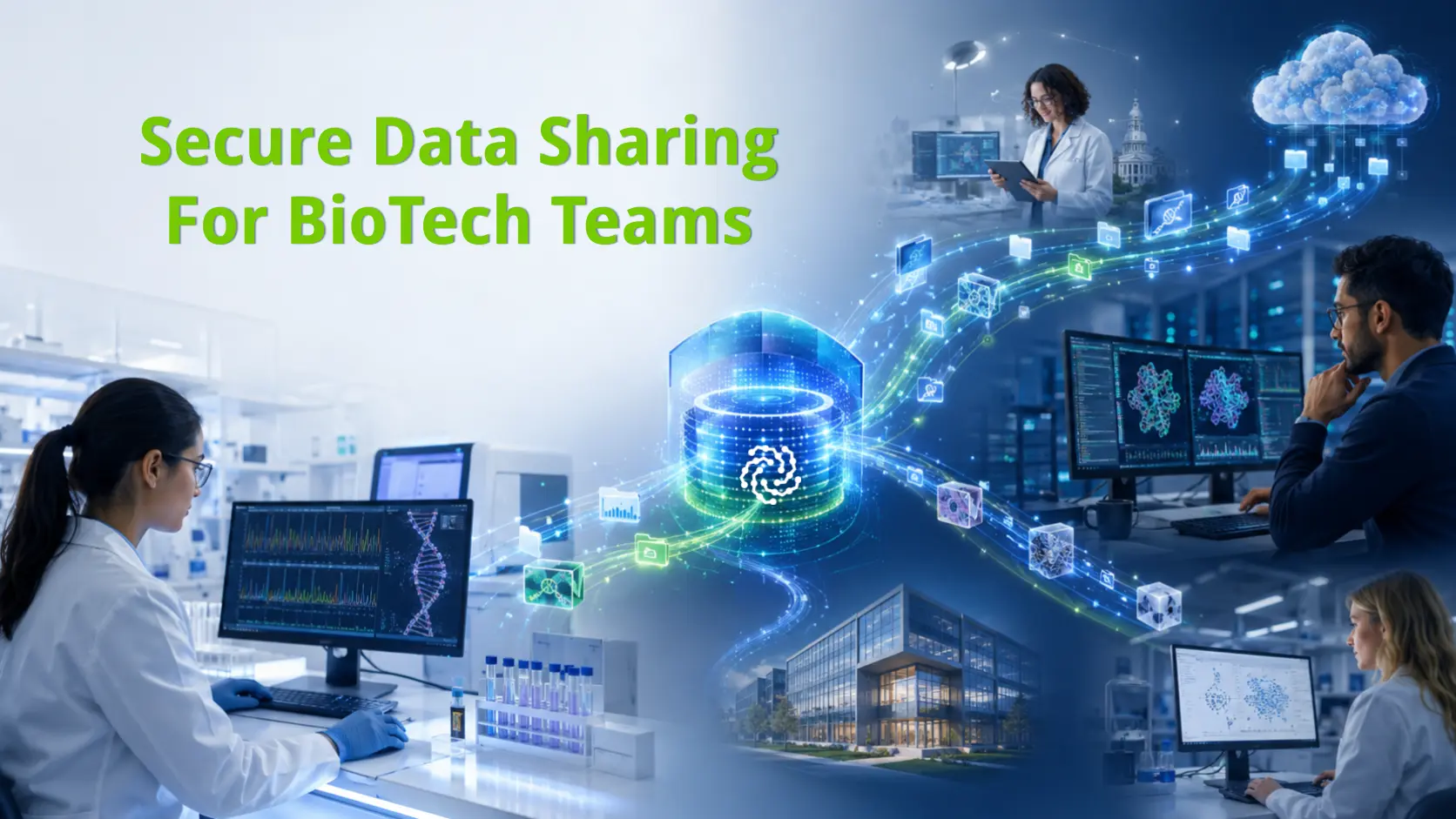
Genomic sequencing results may need to move from a laboratory to a bioinformatics team. A contract research organization may need to deliver a large study dataset to a sponsor. Imaging files may need to reach an academic collaborator. Clinical and preclinical data may need to travel between cloud environments, research institutions, vendors, and external partners.
The scientific value of the data depends partly on whether the right people can receive it securely, reliably, and on time.
That is why teams searching for a secure data sharing platform for biotech teams should look beyond basic file-sharing features. The platform must also address large data volumes, cross-organization collaboration, governance, approvals, auditability, technical differences, and the operational work required to complete a transfer.
MLADU was designed to help organizations manage those challenges.
What Is a Secure Data Sharing Platform for Biotech Teams?
A secure biotech data sharing platform provides a controlled way to exchange research and operational data among authorized people, organizations, and technology environments.
The phrase can describe several types of products:
- Document collaboration systems
- Virtual data rooms
- Electronic laboratory notebooks
- Research data repositories
- Cloud storage platforms
- Managed file transfer tools
- Large-scale data transfer and exchange platforms
These solutions do not all solve the same problem.
A virtual data room may be appropriate for reviewing contracts, intellectual property documents, regulatory files, and due diligence materials. An electronic laboratory notebook may help scientists document experiments. A cloud collaboration platform may help teams work on ordinary documents.
MLADU addresses a different requirement: moving large, sensitive, and complex datasets across cloud, partner, research, and enterprise environments. It is intended for data movement and exchange rather than laboratory record authoring or document-based due diligence
Why Secure Data Sharing Is Difficult for Biotech Organizations
Biotech data sharing often appears simple on a project plan:
- A data provider prepares a dataset.
- An authorized recipient receives it.
- The research continues.
The actual process can involve far more complexity.
Teams may need to coordinate:
- Scientists
- Bioinformaticians
- Data managers
- Cloud administrators
- Information security teams
- Clinical operations teams
- Contract research organizations
- Sequencing laboratories
- Imaging providers
- Academic collaborators
- Data coordinating centers
- Legal and compliance stakeholders
The participating organizations may use different technologies, security procedures, naming conventions, folder structures, and approval processes.
The dataset itself may include:
- Genomic and sequencing data
- Clinical research exports
- Medical and scientific imaging
- Digital pathology data
- Biomarker data
- Multi-omics datasets
- AI and machine learning training data
- Laboratory instrument output
- Preclinical study data
- Research archives
- Partner-submitted datasets
- Regulatory supporting materials
These datasets can contain large individual files, millions of smaller files, deeply nested directories, or hundreds of terabytes of information. MLADU is designed for research, clinical, genomic, imaging, AI, operational, and other large-data use cases that exceed the practical limits of many ordinary collaboration tools.
What Biotech Teams Should Look for in a Secure Data Sharing Platform
1. Encryption During Transfer and Storage
Sensitive research data should be protected both while moving and while temporarily stored.
MLADU's published security controls include:
- TLS 1.2 or higher for data in transit
- AES-256 encryption for data at rest
- Multiple rotating encryption keys
- Web Application Firewall protection
- Isolated customer environments
Encryption alone is not a complete data governance strategy, but it is a foundational requirement.
2. Role-Based Access
Biotech collaboration frequently involves participants with different responsibilities.
A data publisher may prepare and release a dataset. An approver may authorize the transfer. A technical administrator may configure a connection. A recipient may access only the dataset intended for that organization.
A secure platform should allow the organization to define who may perform each activity rather than providing broad, undifferentiated access.
MLADU uses Identity and Access Management and role-based access controls to help organizations establish controlled participation in transfer workflows.
3. Transfer Approval Workflows
Not every technically possible data transfer should occur automatically.
A biotechnology organization may require authorization from:
- A data owner
- A study leader
- A consortium administrator
- An information security representative
- A data governance committee
- A project sponsor
- An authorized transfer approver
MLADU supports transfer approval workflows that can help organizations document authorization before data moves.
This is especially valuable when sensitive data crosses an organizational boundary or when the transfer must follow an established data use agreement, transfer agreement, or internal governance process.
4. Detailed Audit History
Biotech teams may need to answer questions long after a transfer has completed:
- Who requested the transfer?
- Who approved it?
- Which users participated?
- What source and destination were used?
- When did the activity occur?
- What was the transfer outcome?
- Were there exceptions or delays?
- What supporting documentation was preserved?
MLADU provides audit history, transfer visibility, approval records, and role-based governance capabilities intended to improve accountability around data movement.
Auditability does not replace an organization's legal, regulatory, privacy, quality, or compliance responsibilities. It does, however, provide evidence that can support internal reviews and audit preparation.
5. Support for Different Storage Environments
External collaborators rarely use identical systems.
A biotech company may use AWS S3 while a research partner uses Azure Blob Storage. A CRO may deliver files through SFTP. A laboratory may use Box. Another partner may provide data through FTPS or an enterprise transfer product.
MLADU supports commonly used environments and transfer patterns including:
- AWS S3
- Azure Blob Storage
- Box
- Dropbox
- SFTP
- FTPS
- GoAnywhere
- Research platforms
- Partner-managed storage
- Enterprise repositories
This helps teams create a bridge between existing environments rather than requiring every collaborator to adopt the same storage platform before work can begin.
6. Capacity for Large and Complex Datasets
Many systems can securely share a presentation or spreadsheet. Fewer are designed for terabytes of sequencing, imaging, or analytical data.
A biotech data platform should be evaluated against the actual characteristics of the intended transfer:
- Total data volume
- Largest individual file
- Number of files
- Number of directories
- Directory depth
- Available network bandwidth
- Transfer deadline
- Source availability window
- Destination limitations
- Frequency of future transfers
MLADU is intended for large and complex transfer workflows, including high file counts, cloud-to-cloud movement, cross-organization sharing, and recurring partner exchanges.
7. Transfer Visibility
A transfer is not operationally successful merely because a process has started.
Scientists, project managers, sponsors, and data recipients may need to know:
- Whether the transfer is waiting for approval
- Whether the source is ready
- Whether the destination is accessible
- Whether data movement is in progress
- Whether an exception requires attention
- Whether the transfer has completed
- Whether recipient validation is still pending
MLADU gives participating teams visibility into transfer status, approvals, activity, and history.
This reduces the need to rely on disconnected email threads, spreadsheets, and repeated status inquiries.
Common Biotech Data Sharing Scenarios
 CRO-to-Sponsor Data Delivery
|
|---|
|
Contract research organizations regularly deliver large datasets to biotechnology and biopharmaceutical sponsors. These deliveries may include:
MLADU can help connect the provider’s source environment to the sponsor’s approved destination while supporting role-based participation, approvals, audit history, and transfer monitoring. |
|
Sequencing Laboratory Deliveries
|
|---|
|
Sequencing projects can produce substantial volumes of raw and processed data. A laboratory may need to deliver FASTQ, BAM, CRAM, VCF, metadata, quality reports, or related files to a biotech company, university, cloud analysis environment, or bioinformatics partner. A repeatable MLADU workflow can reduce the need to rebuild the transfer process for every sequencing delivery. |
|
Multi-Institution Research Collaboration
|
|---|
|
Biotech research frequently involves universities, academic medical centers, hospitals, nonprofits, government programs, and commercial collaborators. MLADU supports collaboration workflows involving research consortia, academic institutions, biopharma and biotech partnerships, clinical research networks, data coordinating centers, and external partner submissions. |
|
Cloud-to-Cloud Data Exchange
|
|---|
|
A partner may store data in AWS while the receiving organization works in Azure, Box, Dropbox, or another approved environment. Moving data between platforms can require credential coordination, permissions, transfer planning, validation, and stakeholder communication. MLADU helps organizations create repeatable transfer patterns across supported environments without treating each delivery as a new infrastructure project. |
|
Recurring Study Data Collection
|
|---|
|
Longitudinal studies and multi-site research programs may collect updated data monthly, quarterly, or at defined milestones. A secure platform should help the team manage repeated transfers consistently rather than relying on new scripts, credentials, and email instructions each time. |
|
Large Dataset Distribution
|
|---|
|
A biotechnology organization may need to distribute an approved dataset to:
MLADU helps manage the movement of defined datasets to approved destinations while maintaining visibility and audit history. |
Why General-Purpose File Sharing May Not Be Enough
General collaboration tools are valuable for ordinary documents and smaller files. They may become less suitable when a biotech workflow involves:
- Very large datasets
- Millions of files
- Deep folder structures
- Multiple organizations
- Formal approval requirements
- Different cloud platforms
- Strict transfer windows
- Detailed audit expectations
- Limited internal transfer expertise
- Repeated high-volume deliveries
The problem is not necessarily that the general-purpose platform is insecure. The problem is often that it was designed for a different type of collaboration.
Biotech organizations should distinguish between:
Document collaboration:
People review, edit, comment on, and organize working documents.
Data transfer and exchange:
Large datasets move between approved source and destination environments under controlled, auditable workflows.
MLADU is primarily designed for the second requirement.
Why Human Coordination Still Matters
Secure data sharing is not purely technical.
Even a highly automated transfer may depend on:
- A vendor preparing the correct dataset
- A data owner approving the request
- An administrator configuring access
- A recipient making storage available
- A collaborator confirming credentials
- A project manager communicating a deadline
- A researcher validating delivered content
MLADU Concierge adds a human operational layer to the platform.
Depending on the transfer and customer workflow, Concierge can help with:
- Transfer planning
- Participant coordination
- Connection readiness
- Approval coordination
- Transfer monitoring
- Exception management
- Stakeholder updates
- Transfer documentation
This is especially useful when a biotechnology organization has limited internal transfer expertise or when several independent organizations must cooperate.
The customer remains responsible for its data decisions, policies, approvals, and validation. Concierge helps coordinate the process rather than replacing those responsibilities.
Is MLADU the Right Secure Data Sharing Platform for Your Biotech Team?
MLADU may be a strong fit when:
- Your team transfers large research datasets
- Your current tool struggles with data volume or file counts
- Data must move between cloud platforms
- CROs, laboratories, or academic partners submit data regularly
- You need role-based participation
- Transfers require documented approval
- Your organization needs better audit history
- Scientists lack visibility into transfer progress
- IT teams spend too much time troubleshooting deliveries
- Transfers are recurring or operationally complex
- Data must move across organizational boundaries
- You need expert help coordinating participants
MLADU may not replace every data platform used by a biotech company.
Your organization may still need:
- An electronic laboratory notebook
- A laboratory information management system
- A clinical data management platform
- A scientific data repository
- A virtual data room
- An analytics environment
- A cloud data lake
MLADU complements these systems by helping move data securely among them.
Questions to Ask Before Selecting a Platform
Before choosing a secure data sharing platform, ask each vendor:
- What is the maximum supported file size?
- How does the platform handle millions of files?
- Which cloud and transfer environments are supported?
- Can external organizations participate without exposing unrelated data?
- Are permissions role-based?
- Can transfers require approval?
- What audit history is preserved?
- How is data encrypted in transit and at rest?
- Is each customer environment isolated?
- Can the platform support recurring transfers?
- What happens when the destination is temporarily unavailable?
- Who coordinates technical issues between organizations?
- How are transfer exceptions communicated?
- Can supporting agreements and documentation be associated with the workflow?
- What internal infrastructure must the customer maintain?
- How are usage and costs measured?
- Is the platform suitable for the actual data volume and file structure?
- What responsibilities remain with the customer?
The right answer is not simply the platform with the longest feature list. It is the platform that best matches the organization's data, collaborators, governance requirements, operating model, and internal resources.
Frequently Asked Questions
What is a secure data sharing platform for biotech teams?
It is a platform that helps authorized users exchange sensitive research and operational data across internal systems and external organizations. Strong platforms provide encryption, role-based permissions, approvals, transfer visibility, audit history, and support for the environments used by participating teams.
Why do biotech teams need specialized data sharing capabilities?
Biotech workflows frequently involve large datasets, distributed partners, different cloud platforms, sensitive intellectual property, formal approvals, and demanding timelines. Ordinary document-sharing tools may not provide the scale or governance required.
What types of biotech data can MLADU transfer?
MLADU can support large research, genomic, sequencing, clinical, imaging, analytical, AI training, partner-submitted, and operational datasets across supported environments.
How does MLADU protect data?
Published MLADU security controls include TLS 1.2 or higher in transit, AES-256 encryption at rest, Identity and Access Management, role-based access controls, transfer approvals, detailed audit trails, isolated customer environments, and Web Application Firewall protection.
Can MLADU support CRO and laboratory collaboration?
Yes. MLADU can help biotechnology teams exchange data with CROs, laboratories, academic collaborators, vendors, cloud teams, and other authorized partners.
Can MLADU transfer data between different platforms?
MLADU supports transfer patterns involving AWS S3, Azure Blob Storage, Box, Dropbox, SFTP, FTPS, GoAnywhere, partner storage locations, research platforms, and enterprise repositories.
Does MLADU provide approvals and audit history?
Yes. MLADU supports role-based permissions, transfer approval workflows, transfer visibility, and detailed audit history.
Can MLADU handle large biotech datasets?
MLADU is designed for large and complex data transfers, including terabyte-scale datasets, high file counts, complex directories, cloud-to-cloud movement, and recurring partner exchange.
How does MLADU Concierge help?
Concierge can assist with transfer planning, stakeholder coordination, connection readiness, approvals, monitoring, exceptions, communications, and documentation.
Is MLADU a virtual data room or electronic laboratory notebook?
No. MLADU is a secure data transfer and data exchange platform. It complements systems used for laboratory recordkeeping, document collaboration, analytics, and due diligence.
Build a More Reliable Biotech Data Sharing Process
Biotech teams should not have to choose between collaboration and control.
A well-designed data sharing process should make it easier to work with laboratories, CROs, research institutions, cloud teams, and external partners while preserving security, authorization, visibility, and accountability.
MLADU brings large-scale data transfer, role-based governance, approval workflows, audit history, supported cloud and partner connections, and Concierge assistance into one platform.
For biotech teams that have outgrown email attachments, manual scripts, fragmented transfer tools, and one-off delivery processes, MLADU offers a more structured approach to secure data exchange.
Schedule a personalized MLADU demonstration or try the transfer planning experience to evaluate your source systems, destinations, data volume, partner requirements, approval process, and current transfer challenges.
Topics
ON THIS PAGE
ASK A QUESTION
Can't find what you're looking for? Our team is here to help.


Try MLADU Free
Experience the power of AI powered data transfers.

No credit card required