Data Transfer Patterns
Modern organizations generate and exchange enormous amounts of data every day. Research institutions share genomic datasets, biopharmaceutical companies exchange clinical trial data, consortium members collaborate across organizations, and enterprises move information between cloud platforms and business partners.
MLADU simplifies these challenges through a flexible data transfer model designed to securely move data between people, organizations, cloud platforms, and storage systems.
Whether you are transferring a few files or multiple terabytes of research data, MLADU provides a consistent framework for managing, tracking, and auditing every transfer.
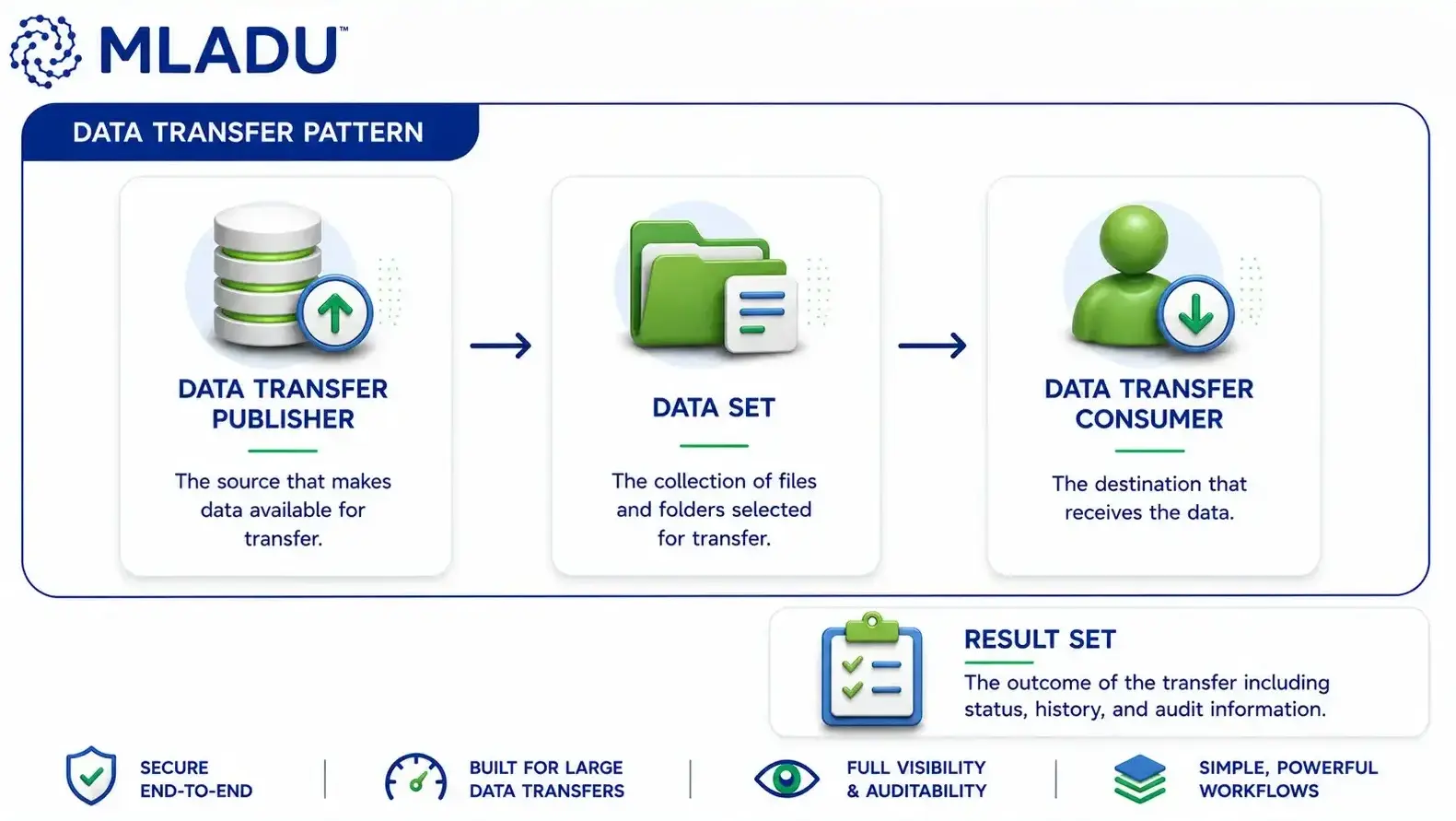
Understanding the MLADU Data Transfer Model
Every MLADU transfer is built using four primary components:
- Publisher
- Consumer
- Data Set
- Result Set
Together, these components form a Data Transfer Pattern that defines how data moves from one location to another.
Publisher
A Publisher is the source of data being transferred.
Publishers make data available for transfer from a connected Data Station.
Examples include:
- AWS S3 buckets
- Azure Blob Storage containers
- Box folders
- Dropbox folders
- SFTP servers
- FTPS servers
- Enterprise file repositories
- Research data repositories
A Publisher may contain a single file, thousands of files, or large datasets consisting of millions of files.
Consumer
A Consumer is the destination that receives transferred data.
Consumers use a Data Station connection to receive data from a Publisher.
Examples include:
- Research collaborators
- Consortium participants
- Cloud storage platforms
- Business partners
- Internal departments
- Compliance archives
- Disaster recovery repositories
A Consumer can receive data from one or more Publishers depending on the selected transfer pattern.
Data Set
A Data Set is a collection of files and folders selected for transfer.
Examples include:
- Clinical trial documentation
- Genomic sequencing results
- Medical imaging files
- Research datasets
- Financial reports
- Application backups
- Compliance artifacts
Data Sets help organize content into logical groups that can be transferred, monitored, audited, and managed within MLADU.
Result Set
A Result Set contains the outcome of a completed transfer operation.
Result Sets provide visibility into:
- Successful transfers
- Failed transfers
- Transfer timestamps
- Audit information
- Validation results
- Transfer history
- Data transfer agreements
- Data transfer specifications
This information helps organizations maintain compliance and verify transfer completion.
Supported Data Transfer Patterns
MLADU supports multiple transfer patterns that accommodate a wide range of business, research, and collaboration requirements.
One-to-One (1:1)
Single Publisher → Single Consumer
The One-to-One pattern is the most common transfer model.
In this configuration, a single Publisher transfers data to a single Consumer.
Example
AWS S3 Bucket → Azure Blob Storage
Common Use Cases
- Research collaboration
- Vendor file exchange
- Cloud migrations
- Secure file sharing
- Backup operations
One-to-Many (1:N)
Single Publisher → Multiple Consumers
The One-to-Many pattern distributes the same Data Set to multiple destinations.
Example
Research Coordinating Center → Multiple Consortium Members
Common Use Cases
- Consortium data distribution
- Global file distribution
- Regulatory submissions
- Data publication
- Partner collaboration
This pattern helps ensure all recipients receive consistent data from a single authoritative source.
Many-to-One (N:1)
Multiple Publishers → Single Consumer
The Many-to-One pattern consolidates data from multiple sources into a centralized destination.
Example
Multiple Clinical Sites → Central Research Repository
Common Use Cases
- Clinical trials
- Data aggregation
- Multi-site studies
- Research collection workflows
- Centralized archiving
This pattern is commonly used by healthcare and life sciences organizations collecting data from numerous participating institutions.
Large Data Transfer Support
Many modern datasets are measured in terabytes rather than gigabytes.
MLADU is designed to support large-scale transfers used by:
- Healthcare organizations
- Research institutions
- Biopharmaceutical companies
- Biotechnology companies
- Clinical research networks
- Consortiums
- Enterprise organizations
Individual File Size Limit
MLADU currently supports individual file sizes up to 4 terabytes (TB) per file.
Dataset Scale
A Data Set may contain:
- Thousands of files
- Hundreds of thousands of files
- Millions of files
- Multiple terabytes of data
This flexibility enables organizations to move large research and enterprise datasets efficiently while maintaining visibility and control throughout the transfer process.
Security and Auditability
Every transfer performed through MLADU is designed with security and accountability in mind.
Transfer activities can be tracked through detailed Result Sets that provide visibility into:
- Transfer status
- Transfer history
- Validation results
- Completion timestamps
- Audit information
These capabilities help organizations support governance, compliance, and operational requirements.
Common Data Transfer Scenarios
Organizations frequently use MLADU for:
Research Data Sharing
Exchange scientific datasets between researchers, institutions, and consortium members.
Clinical Trial Data Collection
Aggregate data from multiple sites into centralized repositories.
Cross-Cloud Transfers
Move data between AWS, Azure, Box, Dropbox, SFTP, and FTPS environments.
Partner Collaboration
Securely exchange data with vendors, customers, and business partners.
Compliance and Archival Workflows
Transfer records into long-term storage and retention systems.
Disaster Recovery
Replicate important data into backup repositories and secondary environments.
Why Organizations Choose MLADU
Organizations choose MLADU because it provides a consistent and scalable framework for managing data movement across diverse environments.
Benefits include:
- Flexible transfer patterns
- Secure data movement
- Large dataset support
- Files up to 4 TB
- Cross-platform connectivity
- Transfer visibility
- Audit-friendly result tracking
- Simplified collaboration
Whether you are transferring research data between consortium members, distributing files globally, aggregating data from multiple sites, or moving information between cloud providers, MLADU provides the tools needed to manage data transfers with confidence.
Topics
ON THIS PAGE
ASK A QUESTION
Can't find what you're looking for? Our team is here to help.


Try MLADU Free
Experience the power of AI powered data transfers.

No credit card required