How FAIR Data Principles Are Changing Research Collaboration
Research Data Is More Valuable When It Can Be Shared
Scientific discoveries have always depended on sharing knowledge.
Today, they also depend on sharing data.
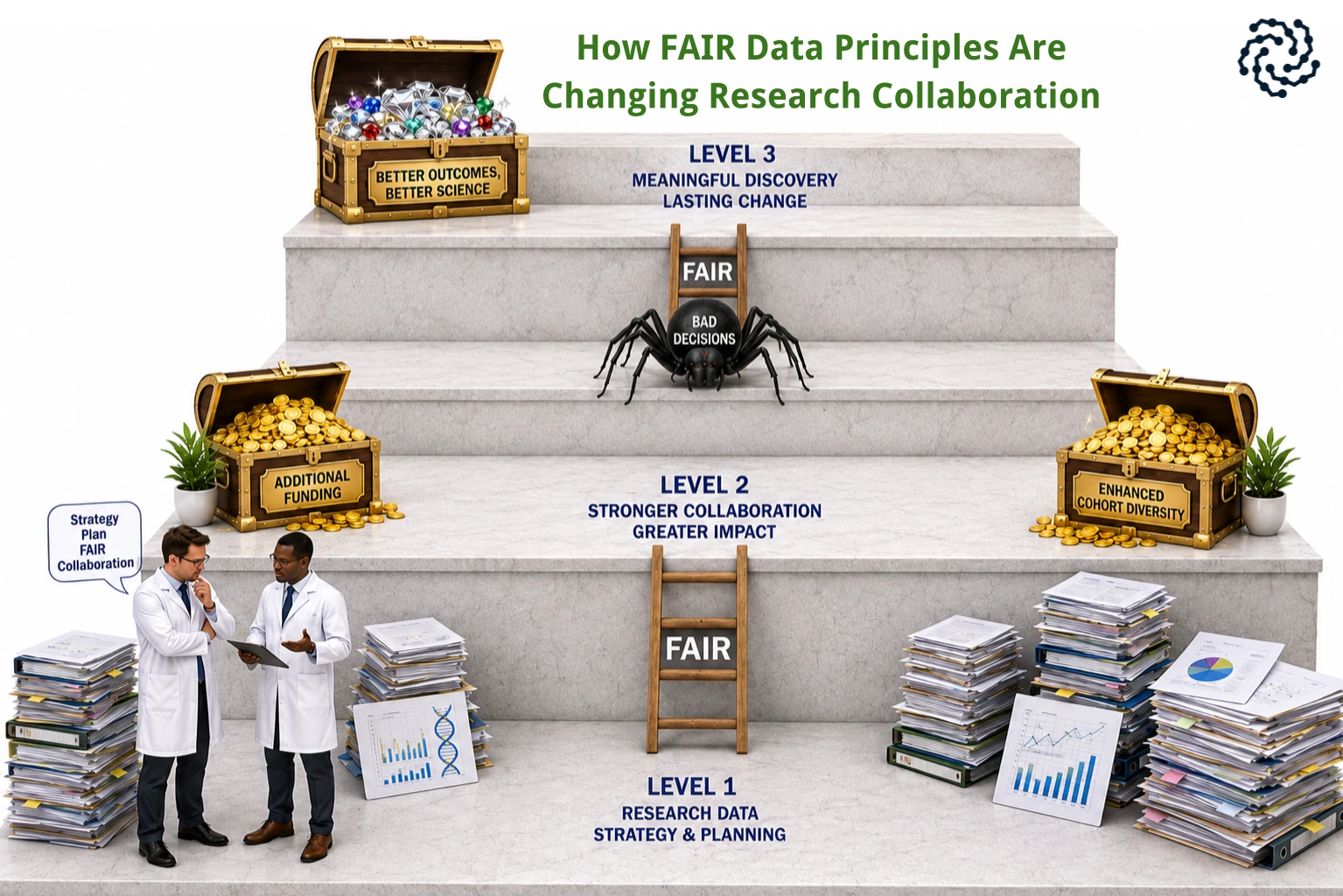
Modern biomedical research generates enormous volumes of genomic, imaging, clinical, proteomic, transcriptomic, and operational data. These datasets often represent years of work, millions of dollars in funding, and the contributions of countless patients, clinicians, and researchers.
Yet data has limited value if it remains isolated inside a single laboratory, institution, or cloud environment.
The greatest scientific discoveries increasingly come from researchers who can responsibly share, combine, analyze, and build upon each other's work.
This is the idea behind the FAIR Data Principles.
What Are the FAIR Data Principles?
In 2016, an international group of researchers introduced the FAIR Guiding Principles for Scientific Data Management and Stewardship.
FAIR encourages research data to be:
- Findable
- Accessible
- Interoperable
- Reusable
The principles were published in Scientific Data and have since become one of the most influential frameworks for research data management worldwide.
Importantly, FAIR does not require that all research data be openly available.
Instead, it promotes making data as accessible and reusable as appropriate while respecting privacy, security, governance, intellectual property, and ethical obligations.
The original publication remains one of the foundational references for modern scientific data management.
FAIR Guiding Principles for Scientific Data Management and Stewardship
Why FAIR Matters More Than Ever
Research has become increasingly collaborative.
A single study may involve:
- Universities
- Academic medical centers
- Children's hospitals
- Government agencies
- Biotechnology companies
- Pharmaceutical organizations
- International research consortiums
Every organization generates valuable data.
The challenge is enabling researchers to discover, access, interpret, and responsibly reuse that data across institutional boundaries.
FAIR provides a common philosophy for making this possible.
FAIR Is About More Than Data Storage
One common misconception is that FAIR is simply a storage strategy.
It is not.
FAIR influences nearly every aspect of research data management, including:
- Metadata standards
- Data documentation
- File organization
- Data identifiers
- Access procedures
- Interoperability
- Long-term stewardship
- Responsible reuse
In other words, FAIR changes how research organizations think about the entire lifecycle of scientific data.
FAIR Encourages Better Collaboration
Perhaps the greatest impact of FAIR has been on research collaboration.
When datasets are easier to discover and understand, researchers spend less time searching for information and more time conducting science.
When data follows consistent standards, organizations can collaborate more efficiently.
When access procedures are well documented, consortiums can share information with greater confidence.
FAIR helps reduce friction throughout the research process.
FAIR Does Not Mean "Open to Everyone"
This is one of the most misunderstood aspects of FAIR.
Accessible does not mean unrestricted.
Many biomedical datasets contain sensitive information that requires careful governance.
Patient privacy, informed consent, contractual obligations, and institutional policies remain critically important.
The FAIR Principles explicitly recognize that access should be appropriate for the sensitivity of the data.
Some datasets may require:
- Authentication
- Authorization
- Data Use Agreements
- Institutional approvals
- Consortium governance
- Controlled access procedures
FAIR supports responsible sharing, not unrestricted sharing.
FAIR and the NIH Data Management and Sharing Policy
The FAIR Principles have significantly influenced research funding organizations around the world.
The NIH Data Management and Sharing Policy encourages federally funded researchers to plan for how scientific data will be managed, preserved, and shared throughout the research lifecycle.
Although the NIH policy does not require strict FAIR compliance, its goals strongly align with FAIR concepts, including improving the discoverability, accessibility, and long-term value of scientific data.
Researchers increasingly view FAIR as a practical framework for supporting these expectations.
FAIR Requires More Than Good Intentions
Many organizations want to embrace FAIR.
The challenge is implementation.
Researchers often discover that collaboration is slowed by:
- Different cloud platforms
- Different storage systems
- Different metadata practices
- Different security requirements
- Different governance policies
- Different access procedures
The scientific community may share common goals, but the underlying technology environments often differ significantly.
Supporting FAIR requires infrastructure that enables organizations to collaborate despite these differences.
How MLADU Supports FAIR-Aligned Research Collaboration
MLADU was designed to simplify one of the most challenging aspects of FAIR implementation: securely exchanging research data between organizations.
While MLADU does not create metadata or determine whether data is FAIR, it supports FAIR-aligned collaboration by making data exchange more secure, governed, and interoperable.
MLADU helps organizations:
- Exchange large research datasets across institutional boundaries.
- Connect cloud and on-premises storage environments.
- Maintain complete transfer visibility.
- Support role-based access controls.
- Document transfer approvals.
- Preserve comprehensive audit histories.
- Enable secure collaboration between consortium members.
By reducing operational barriers to data sharing, MLADU helps researchers spend less time managing infrastructure and more time advancing science.
FAIR in Practice: What It Looks Like During a Research Data Transfer
MLADU bridges the gap between abstract FAIR concepts and day-to-day research operations and simplifies governed, interoperable research data exchange.
| FAIR Principle | How It Applies During A MLADU Data Transfer |
|---|---|
| Findable | Researchers know where approved datasets are located and how to request access. |
| Accessible | Authorized collaborators can securely retrieve data through governed access controls. |
| Interoperable | Data moves between cloud providers, institutional storage, and research platforms without requiring custom workflows. |
| Reusable | Audit history, provenance, and governance records help future researchers understand and confidently reuse shared datasets. |
FAIR Is Transforming the Future of Research
FAIR is more than a set of principles.
It represents a shift in how the scientific community thinks about research data.
Instead of viewing datasets as isolated project outputs, researchers increasingly recognize them as long-term scientific assets that can accelerate future discovery when managed responsibly.
Organizations that embrace FAIR-aligned practices are better positioned to:
- Strengthen research collaborations.
- Improve reproducibility.
- Increase the value of funded research.
- Support data reuse.
- Accelerate scientific discovery.
- Prepare for future funding expectations.
The future of research belongs to organizations that make data not only secure, but also discoverable, understandable, and responsibly reusable.
References
For additional information about FAIR data and responsible scientific data management, explore these trusted resources:
- FAIR Guiding Principles for Scientific Data Management and Stewardship (Nature Scientific Data)
- GO FAIR Initiative
- National Institutes of Health (NIH)
- NIH Data Management & Sharing Policy
- NIH Office of Data Science Strategy
- Research Data Alliance (RDA)
Topics
ON THIS PAGE
ASK A QUESTION
Can't find what you're looking for? Our team is here to help.


Try MLADU Free
Experience the power of AI powered data transfers.

No credit card required