How MLADU Supports FAIR Data Principles for Modern Research Organizations
Accelerating Scientific Discovery Through Better Data Accessibility, Mobility, and Governance
Research organizations today generate more data than ever before.
Genomics, proteomics, clinical trials, medical imaging, AI model training, bioinformatics pipelines, and real-world evidence initiatives are producing terabytes and even petabytes of valuable scientific data. While creating data has become easier, managing, sharing, and leveraging that data effectively remains a significant challenge.
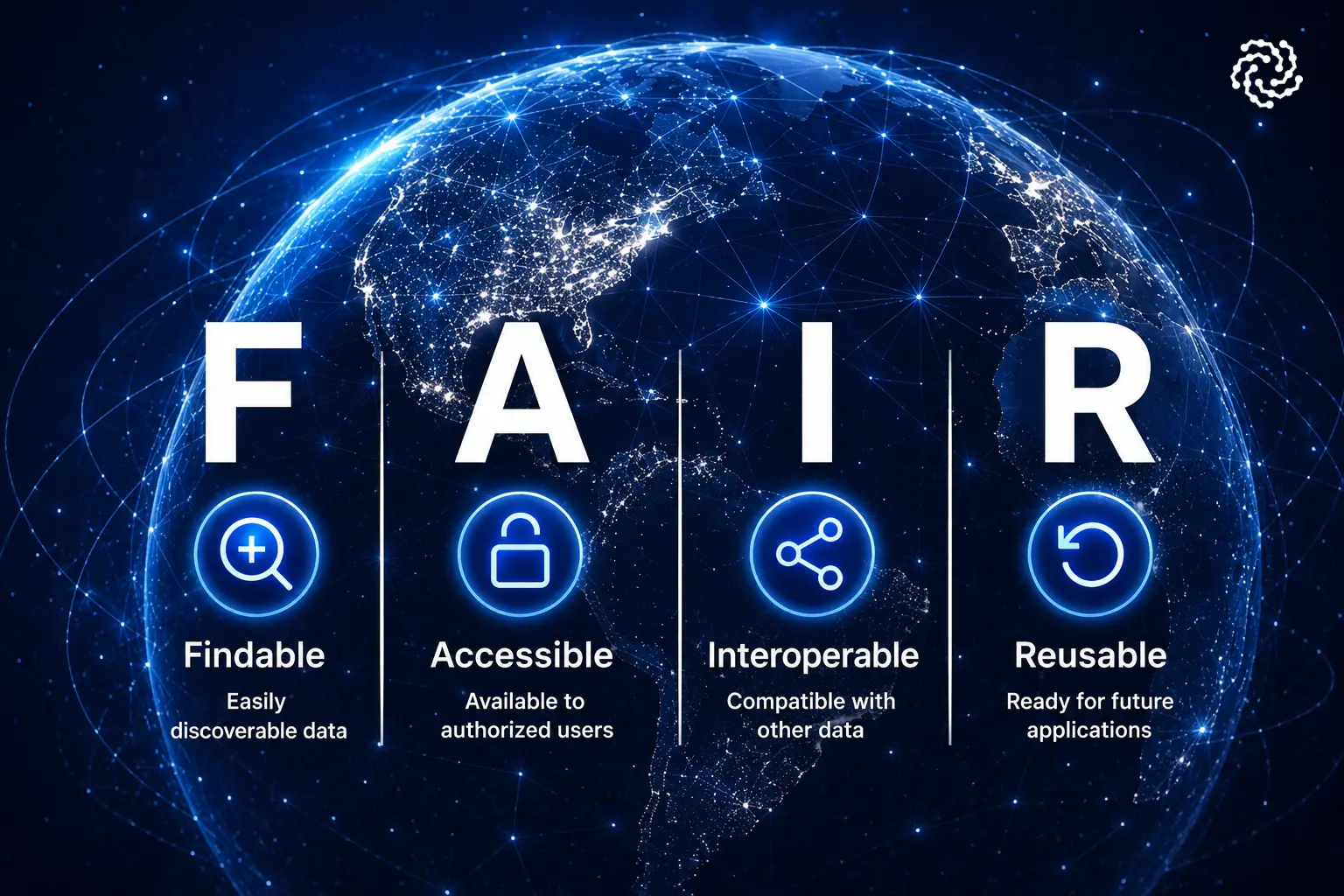
To address this challenge, many organizations have adopted the FAIR Data Principles, a framework designed to ensure research data is Findable, Accessible, Interoperable, and Reusable.
The FAIR principles have become a cornerstone of modern scientific research because they help organizations maximize the value of their data while improving collaboration, reproducibility, compliance, and innovation.
However, implementing FAIR principles requires more than simply storing data.
Organizations must be able to move data efficiently, maintain data integrity, support collaboration, preserve metadata, provide auditability, and ensure that data remains accessible across a diverse ecosystem of platforms and users.
This is where MLADU can help.
What Are FAIR Data Principles?
FAIR stands for:
F – Findable
Data should be easy to locate and identify.
Researchers should be able to discover datasets quickly using meaningful metadata, naming conventions, and cataloging practices.
A – Accessible
Authorized users should be able to access data when needed.
Accessibility includes secure authentication, authorization, and reliable methods for retrieving data.
I – Interoperable
Data should work across different systems, platforms, organizations, and tools.
Interoperability enables collaboration between institutions and supports evolving technology ecosystems.
R – Reusable
Data should be preserved, documented, and managed in a manner that allows future use.
Reusable data accelerates scientific discovery and improves return on research investments.
Why FAIR Data Matters
The FAIR framework is not simply a best practice.
Many funding agencies, research consortiums, academic institutions, and life sciences organizations now require FAIR-aligned data management strategies.
Organizations that embrace FAIR principles often experience:
- Improved research collaboration
- Faster scientific discovery
- Better data governance
- Increased data transparency
- Stronger compliance postures
- Reduced duplication of effort
- Greater return on research investments
The challenge is that FAIR implementation often becomes difficult when data is distributed across multiple cloud providers, storage systems, research platforms, and geographic locations.
How MLADU Supports FAIR Data Principles
MLADU was designed to simplify the movement, management, and accessibility of large datasets across complex research environments.
While FAIR is broader than any single technology platform, MLADU provides several capabilities that directly support FAIR-aligned data strategies.
Supporting Findable Data
Data cannot be found if it is scattered across disconnected storage environments.
Research organizations frequently maintain data across:
- AWS S3
- Azure Blob Storage
- SFTP servers
- Institutional repositories
- Research collaboration portals
- On-premises storage systems
MLADU helps centralize visibility into data movement activities through its Data Station and Data Set architecture.
Data Stations
Data Stations create a structured representation of storage locations and endpoints.
Organizations can assign:
- Unique identifiers
- Descriptive names
- Documentation
- Ownership information
This creates consistency and improves visibility across complex storage environments.
Data Sets
MLADU Data Sets provide logical grouping and organization of research data.
Rather than managing millions of individual files independently, researchers can work with organized collections of data that are easier to identify, locate, and manage.
These capabilities help support the "Findable" component of FAIR by improving organizational structure and data discoverability.
Supporting Accessible Data
Accessibility is one of the most challenging aspects of FAIR implementation.
Research data often resides in multiple cloud environments, institutional repositories, and external collaboration platforms.
MLADU simplifies accessibility by providing secure movement of data between supported platforms without requiring researchers to manually download, upload, or relocate files.
Secure Access Controls
MLADU provides role-based access capabilities through multiple user roles, including:
- Technical Administrators
- Data Owners
- Portal Administrators
- Additional operational roles
This ensures that authorized users can access the data they need while maintaining governance controls.
Cloud-to-Cloud Accessibility
MLADU supports data movement across platforms including:
- AWS S3
- Azure Blob Storage
- SFTP
- FTPS
- Dropbox
- Other supported storage environments
By reducing technical barriers between systems, MLADU helps make research data more accessible to authorized collaborators.
Supporting Interoperable Data
Research rarely occurs within a single technology platform.
Organizations increasingly operate within multi-cloud environments where data must move seamlessly between systems.
A dataset may originate in Azure, undergo processing in AWS, and ultimately be shared with collaborators through a secure transfer platform.
MLADU was built specifically for this challenge.
Multi-Platform Connectivity
MLADU Data Stations allow organizations to connect multiple storage technologies into a unified transfer ecosystem.
Researchers can move data between platforms without developing custom scripts or building specialized transfer infrastructure.
Standardized Data Movement
MLADU provides a consistent process for transferring data regardless of storage location.
This standardization helps reduce operational complexity while supporting interoperability across research environments.
The ability to move data reliably between platforms is a foundational requirement for FAIR-compliant collaboration.
Supporting Reusable Data
Reusable data requires confidence that the information remains complete, accurate, and trustworthy.
Researchers must know that data has not been corrupted, altered, or lost during movement.
Data Integrity Verification
MLADU automatically validates transferred data using integrity verification processes.
This helps ensure that datasets arrive intact and remain suitable for downstream research activities.
Audit Trails
MLADU maintains detailed audit histories of transfer activities.
Organizations gain visibility into:
- Transfer events
- User activities
- Transfer outcomes
- Operational history
Auditability supports trust and transparency, both of which are essential for data reuse.
Data Versioning and Replication
MLADU supports capabilities such as versioning and replication, helping organizations preserve critical datasets and maintain long-term usability.
These capabilities support research reproducibility and improve confidence in shared data assets.
FAIR Data at Scale
FAIR principles become increasingly difficult to implement as datasets grow larger.
Research organizations routinely manage:
- Hundreds of terabytes
- Millions of files
- Multi-cloud environments
- International collaborations
- Long-term retention requirements
Manual processes often become unsustainable at this scale.
MLADU was purpose-built for large-scale data movement and management, enabling organizations to support FAIR initiatives without introducing additional operational burden.
By combining automation, cloud-native scalability, auditability, and secure collaboration, MLADU helps research organizations build data strategies that align with FAIR principles while remaining practical to operate.
FAIR Data Is About More Than Storage
Many organizations assume FAIR compliance begins and ends with storing data.
In reality, FAIR requires the ability to discover, access, move, share, validate, and preserve information across the entire research lifecycle.
Data that cannot be moved efficiently between collaborators, platforms, and research environments ultimately becomes less valuable.
MLADU helps bridge this gap by simplifying large-scale data movement while supporting the governance, visibility, and accessibility that FAIR principles demand.
Start Building a FAIR-Aligned Data Strategy
Whether your organization is supporting genomics research, clinical development, bioinformatics, AI initiatives, or multi-institution collaborations, FAIR data principles can help maximize the value of your research investments.
MLADU provides the tools needed to move, organize, verify, and manage large datasets across complex environments while supporting the accessibility and collaboration that modern science requires.
Ready to Simplify FAIR Data Management?
Schedule a personalized MLADU demonstration to see how Data Stations, Data Sets, automated transfers, audit trails, integrity verification, and cloud-scale automation can help your organization support FAIR data principles.
Or start a free trial and discover how easy it can be to move and manage research data at scale.
Move data faster. Collaborate more effectively. Support FAIR data principles with MLADU.
Topics
ON THIS PAGE
ASK A QUESTION
Can't find what you're looking for? Our team is here to help.


Try MLADU Free
Experience the power of AI powered data transfers.

No credit card required