How to Transfer 50 Terabytes from Azure Storage to AWS S3 Across Regions in Hours, Not Weeks
The Fastest Way to Move Massive Research Data Sets to AWS
Moving 50 terabytes of data from Azure Storage to AWS S3 in different regions sounds simple until you actually have to do it.
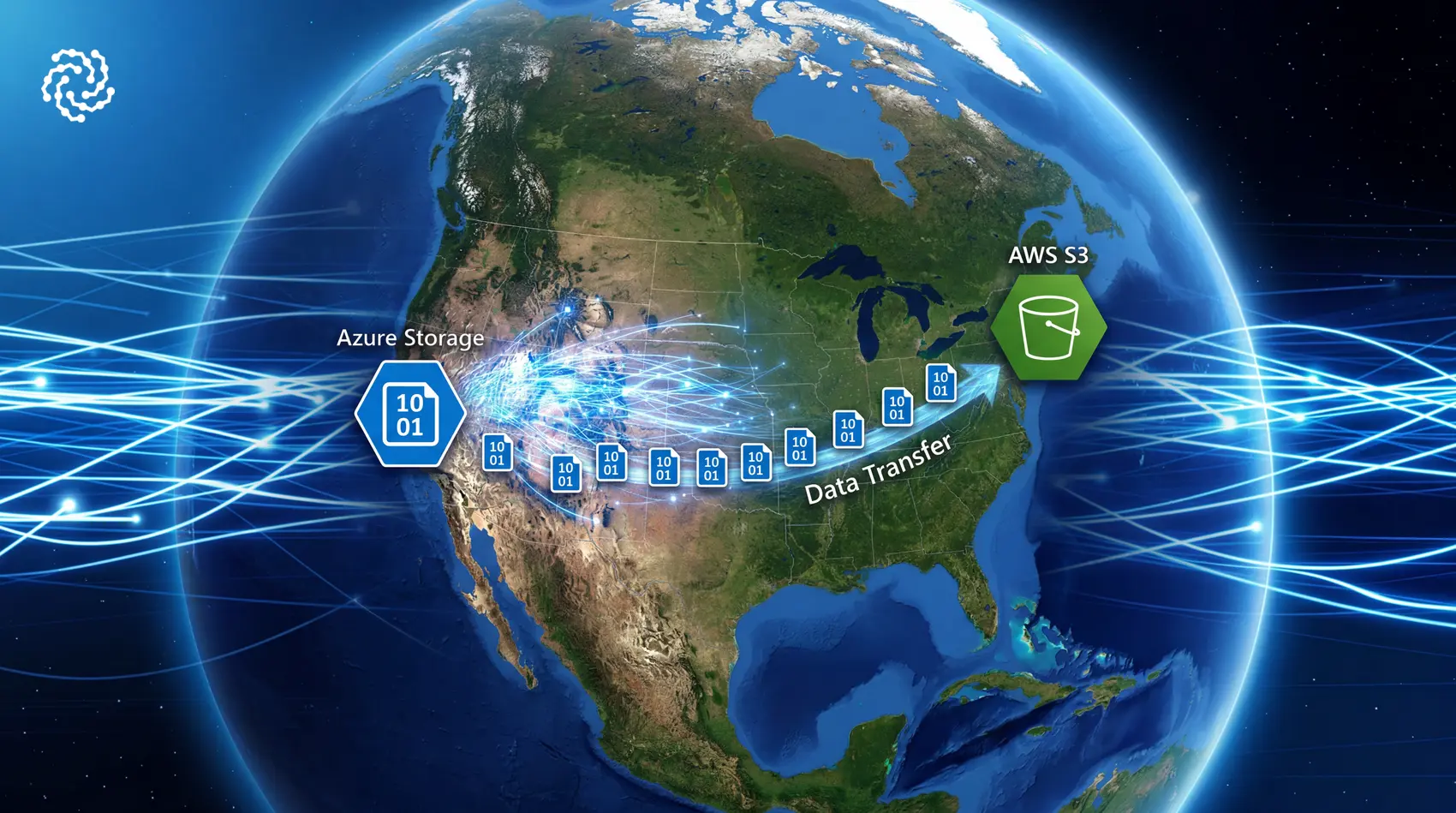
For biopharma, biotech, genomics, clinical research, AI, and life sciences organizations, large-scale cloud migrations are becoming increasingly common. Research teams generate enormous volumes of sequencing data, imaging data, clinical trial data, machine learning training data, and analytical outputs that often need to be transferred between cloud providers.
Unfortunately, most organizations discover that transferring 50 TB from Azure Blob Storage to AWS S3 is far more complicated than expected.
Questions quickly arise:
- How long will the transfer take?
- Will the data remain secure?
- How do we verify every file arrived correctly?
- What happens if the transfer fails halfway through?
- How much manual effort is required?
- Can we avoid downloading data to local systems?
- How do we monitor progress across hundreds of thousands or millions of files?
The good news is that there is a much easier solution.
The Traditional Approach to Azure-to-AWS Data Transfers
Many organizations initially attempt to transfer large datasets manually.
This often involves:
- Downloading data from Azure
- Splitting data into smaller chunks
- Writing custom scripts
- Building temporary infrastructure
- Monitoring transfer jobs manually
- Verifying checksums manually
- Re-transferring failed files
- Managing credentials across multiple cloud platforms
For a 50 TB transfer, this process can become a full-time project.
Teams frequently spend days or weeks troubleshooting transfer failures, restarting jobs, validating data integrity, and managing operational risk.
The larger the dataset becomes, the greater the complexity.
This is especially problematic for biotechnology and pharmaceutical organizations where research timelines, regulatory requirements, and scientific outcomes depend on accurate data movement.
The Simple Alternative: MLADU
MLADU was purpose-built to solve large-scale cloud data transfers.
Instead of spending weeks planning and managing a transfer, the process can be completed in just a few simple steps.
Step 1: Sign Up for MLADU. Select an affordable MLADU subscription plan that fits your organization's transfer needs.
Step 2: Select New Transfer. Simply click the button to let MLADU know that you are requesting a new transfer.
Step 3: Enter the Source Azure Storage Connection Details. Select a pre-existing MLADU data station or enter in the source Azure Storage details to create a new data station.
Step 4: Enter the Target AWS S3 Connection Details. Select a pre-existing MLADU data station or enter in the target AWS S3 details to create a new data station.
Step 5: Follow the guided prompts and click Go. That's it. MLADU automatically begins orchestrating the transfer.
You receive notifications as the transfer progresses, while the MLADU Concierge team is automatically alerted and begins actively monitoring the transfer from start to finish.
- No scripting.
- No custom infrastructure.
- No software installation.
- No laptop downloads.
- No manual transfer management.
- No babysitting your laptop to keep a processing window open.
Why MLADU Is the Best Way to Transfer 50 TB from Azure to AWS
1. Purpose-Built for Speed
When organizations need to move 50 terabytes of research data, speed matters.
MLADU was designed specifically for high-performance, large-scale data movement.
The platform has consistently demonstrated the ability to complete large cloud-to-cloud transfers in hours rather than days or weeks.
For research organizations operating under project deadlines, regulatory timelines, or competitive pressures, faster data movement directly accelerates scientific outcomes.
2. Designed to handle large volumes of data
One of the biggest frustrations organizations encounter is discovering that many file transfer platforms impose strict transfer limits.
Some solutions struggle with transfers larger than a few gigabytes.
Others become operationally challenging once transfers exceed a few hundred gigabytes.
A 50 TB transfer can quickly exceed the practical limits of traditional transfer tools.
MLADU was built specifically for large-scale transfers.
Whether your organization needs to move:
- 10 TB
- 50 TB
- 100 TB
- 1 petabyte
MLADU provides a scalable solution designed to handle enterprise and research-scale workloads.
3. Fully Automated and AI-Powered
Large transfers involve far more than simply copying files.
Organizations must also:
- Monitor transfer health
- Detect failures
- Verify data integrity
- Track completion status
- Generate audit records
- Confirm successful delivery
Without the right platform, teams often break transfers into smaller chunks and manually manage each stage.
This creates significant operational risk.
MLADU leverages AI-powered processes to automate data movement, inspection, monitoring, validation, and verification.
The result is dramatically reduced operational effort and significantly lower risk.
4. No Downloads or Software Installation Required
Many traditional transfer methods require:
- Desktop software
- VPN configurations
- Specialized transfer tools
- Local storage
- Temporary staging environments
MLADU eliminates these requirements.
Users simply provide source and destination information through the platform.
MLADU handles the heavy lifting behind the scenes.
This reduces complexity while accelerating project timelines.
5. MLADU Concierge Monitors Your Transfer
One of the most unique aspects of MLADU is the Concierge service.
Most transfer platforms leave customers on their own after the transfer starts.
MLADU takes a different approach.
When your transfer begins, MLADU Concierge is automatically notified.
Specialists actively monitor the transfer lifecycle, helping ensure that the transfer progresses smoothly from initiation through completion.
This human oversight provides an additional layer of confidence that is especially valuable when moving mission-critical research data.
6. Cloud-Native Scale Without Operational Burden
Transferring 50 TB requires significant infrastructure and orchestration.
Building that capability internally can be expensive and time-consuming.
MLADU leverages the power of cloud-native architectures and AI-driven automation to scale transfer operations without requiring customers to build or manage the underlying infrastructure.
The platform automatically scales to meet the demands of large datasets while allowing research teams to remain focused on science rather than data logistics.
7. Affordable Subscription Pricing
Organizations often assume that enterprise-scale transfers require enterprise-scale budgets.
MLADU challenges that assumption.
Customers can subscribe to affordable plans and accumulate rollover transfer capacity over time.
Much like AI token consumption models, unused transfer capacity rolls forward, allowing organizations to build transfer capacity and execute large data movements when needed.
This creates a highly cost-effective strategy for organizations that periodically move large datasets.
Instead of paying for expensive infrastructure that sits idle, organizations can maintain a subscription and utilize accumulated transfer capacity when major transfers arise.
Common Use Cases for Azure-to-AWS Transfers
MLADU is particularly well-suited for:
- Genomics data transfers
- Clinical trial data migrations
- Pharmaceutical research data movement
- AI and machine learning datasets
- Bioinformatics workflows
- Imaging repositories
- Multi-cloud data strategies
- Research collaborations
- Mergers and acquisitions
- Data lake migrations
- AWS modernization initiatives
Stop Managing Transfers. Start Moving Data.
Moving 50 terabytes from Azure Storage to AWS S3 across regions should not require weeks of planning, scripting, troubleshooting, and monitoring.
With MLADU, the process is remarkably simple:
- Sign up.
- Select New Transfer.
- Enter your Azure Storage details.
- Enter your AWS S3 details.
- Follow Prompts and Click Go.
MLADU handles the transfer.
MLADU AI monitors the process.
MLADU Concierge oversees the operation.
Your team stays focused on research, innovation, and business outcomes instead of managing data logistics.
Start Your Free Trial Today
Ready to transfer terabytes of data without the complexity?
Start your free MLADU trial today and discover how easy large-scale cloud data transfers can be.
Schedule a personalized demo to see how MLADU can help your organization move data faster, reduce risk, and eliminate the operational burden of large-scale transfers.
Transfer terabytes in hours. Scale to a petabyte. Let MLADU do the work.
Topics
ON THIS PAGE
ASK A QUESTION
Can't find what you're looking for? Our team is here to help.


Try MLADU Free
Experience the power of AI powered data transfers.

No credit card required