The Biggest Bottleneck in Modern Research Is Not Storage. It Is Moving Data.
Research Has Changed Dramatically
Twenty years ago, most research data could fit comfortably on a desktop computer or external hard drive. Today, a single sequencing project, digital pathology study, imaging initiative, or AI training dataset can generate terabytes or even petabytes of data.
While the ability to generate scientific data has accelerated at an extraordinary pace, the ability to move that data between researchers, institutions, cloud providers, and collaborators has not kept up.
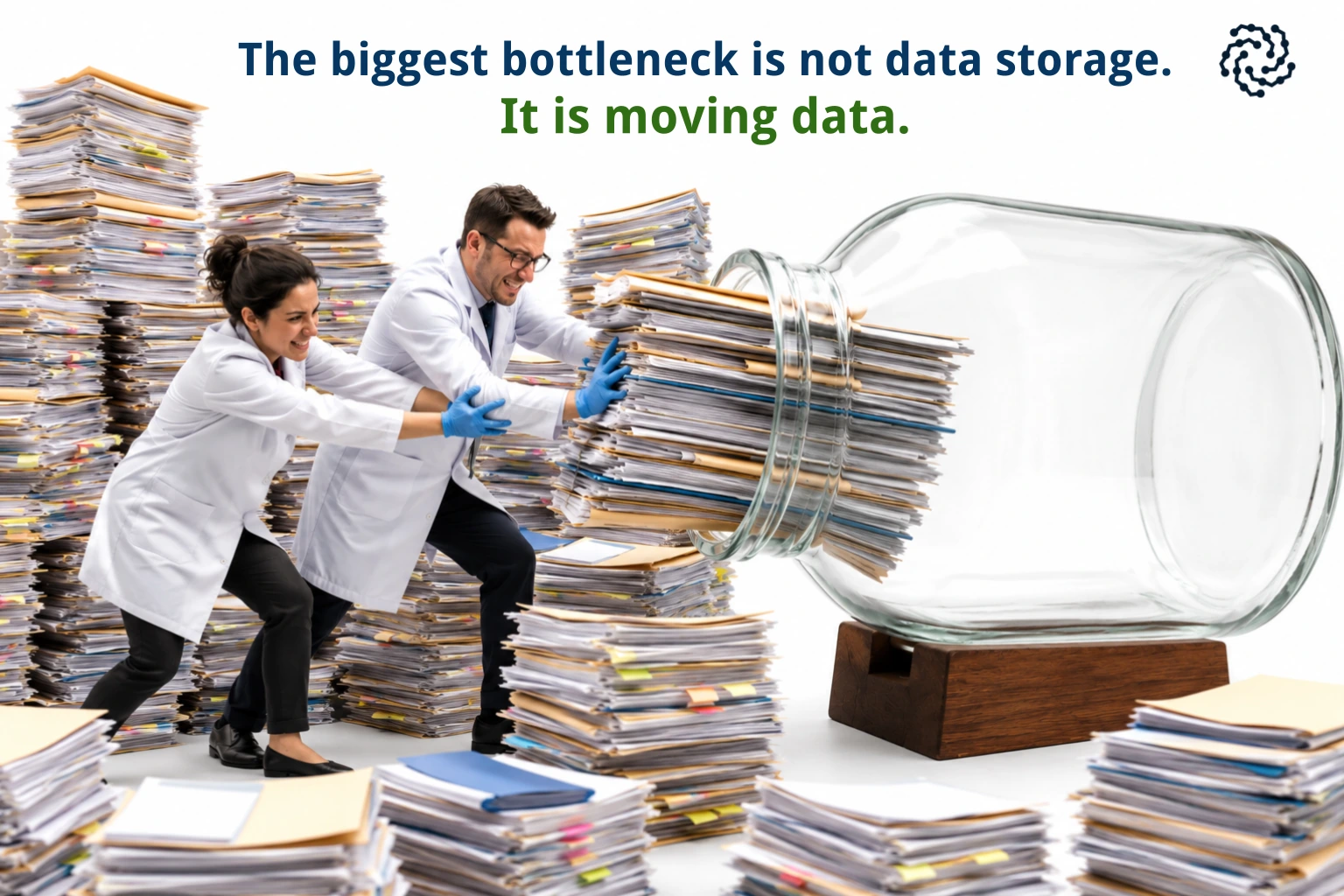
For many research organizations, the next major bottleneck is no longer collecting data.
It is sharing it.
Whether you are supporting a multi-site clinical trial, collaborating with international research partners, or managing a rare disease consortium, transferring research data has quietly become one of the most difficult and time-consuming parts of modern science.
The Growth of Research Data Is Outpacing Data Movement
The life sciences community is producing more data than ever before.
Examples include:
- Whole genome sequencing
- Multi-omics research
- Digital pathology
- Medical imaging
- Cryo-electron microscopy
- AI and machine learning training datasets
- Electronic clinical research records
Organizations such as the National Institutes of Health (NIH) continue to invest heavily in initiatives that encourage broader data sharing because collaborative research accelerates scientific discovery.
Likewise, the NIH Data Management and Sharing Policy now requires many federally funded researchers to plan for how scientific data will be managed and shared throughout the research lifecycle.
Creating data has become easier.
Moving it securely remains surprisingly difficult.
Why Large Research Data Transfers Fail
Many researchers assume moving data should be as simple as uploading files to cloud storage.
Unfortunately, research data presents unique challenges.
Large transfers often include:
- Hundreds of thousands of files
- Millions of files
- Deep directory structures
- Individual files measuring multiple terabytes
- Data stored across multiple cloud providers
- On-premises storage
- High-latency international networks
Traditional file transfer methods were never designed for this level of complexity.
Researchers frequently encounter:
- Interrupted uploads
- Failed transfers
- Network timeouts
- Manual restart processes
- Limited visibility into transfer progress
- Inconsistent security controls
- Difficulty sharing data across institutions
The result is valuable researcher time spent troubleshooting infrastructure instead of advancing science.
Storage Is No Longer the Hard Part
Cloud storage has become relatively inexpensive and highly scalable.
Moving data between storage platforms is another matter entirely.
A single research collaboration may require transferring data between:
- Amazon S3
- Microsoft Azure Blob Storage
- Secure FTP servers
- Institutional storage systems
- Research portals
- Commercial cloud platforms
- External collaborators
Each environment introduces different authentication methods, security policies, permissions, and technical requirements.
Instead of a simple exchange, researchers often spend days coordinating access before a transfer even begins.
The Hidden Cost of Slow Data Transfers
Every delayed transfer has consequences.
Researchers may experience:
Delayed Publications
Scientific manuscripts often depend on timely data availability across multiple institutions.
Slower Clinical Trials
Clinical trial sites cannot analyze data they have not yet received.
Delayed AI Model Training
Artificial intelligence projects require large datasets that must be consolidated before training begins.
Increased Operational Costs
Failed transfers consume valuable researcher and IT staff time.
Collaboration Friction
Researchers should be collaborating on discoveries, not troubleshooting network interruptions.
Modern Research Requires Modern Data Exchange
Today's research environment demands more than simply copying files.
Researchers increasingly need platforms capable of:
- Moving hundreds of terabytes
- Supporting millions of files
- Connecting multiple cloud providers
- Maintaining complete audit histories
- Protecting sensitive research data
- Providing transfer visibility
- Supporting institutional governance
- Simplifying collaboration
This is especially true for research consortiums where multiple organizations must exchange data securely while maintaining regulatory and contractual obligations.
Why Governance Matters During Data Transfer
Moving research data is not only a technical challenge.
It is also a governance challenge.
Research organizations increasingly need to answer questions such as:
- Who approved this transfer?
- Who uploaded the data?
- Who downloaded the data?
- When was the transfer completed?
- Was the data delivered successfully?
- Can we produce an audit trail?
These requirements are becoming increasingly common under institutional policies, funding agency expectations, and collaborative research agreements.
As research becomes more collaborative, secure governance becomes just as important as transfer speed.
How MLADU Simplifies Large Research Data Transfers
MLADU was designed specifically to address the challenges of modern research data exchange.
Instead of forcing researchers to build custom transfer workflows, MLADU provides a secure, cloud-native platform designed for transferring large research datasets between organizations.
Researchers can securely exchange:
- Genomic datasets
- Clinical research data
- Imaging data
- Multi-omics data
- AI training datasets
- Operational research data
Across environments including:
- Amazon S3
- Microsoft Azure Blob Storage
- Box
- Dropbox
- FTPS
- SFTP
- Additional enterprise storage platforms
MLADU also provides features that support research collaboration, including:
- Secure encrypted transfers
- Transfer approvals
- Complete audit history
- Role-based access controls
- Transfer status visibility
- Dedicated customer environments
- Concierge assistance for complex transfers
The result is less time managing infrastructure and more time advancing research.
The Future of Research Depends on Data Mobility
Scientific discovery increasingly depends on collaboration.
The organizations that can securely exchange data faster will also be better positioned to accelerate research, support clinical trials, train AI models, and bring new therapies to patients.
Storage will continue to grow.
Networks will continue to improve.
But the organizations that solve the challenge of governed, secure, large-scale data exchange will unlock the greatest value from their research investments.
Moving data is no longer a background IT task.
It has become one of the most important components of modern scientific collaboration.
References
To learn more about research data sharing and data management, see:
- NIH Data Management & Sharing Policy
- NIH Office of Data Science Strategy
- FAIR Principles for Scientific Data Management and Stewardship (Nature Scientific Data)
- GO FAIR Initiative
Topics
ON THIS PAGE
ASK A QUESTION
Can't find what you're looking for? Our team is here to help.


Try MLADU Free
Experience the power of AI powered data transfers.

No credit card required