MLADU Custom API Integration
Applications built around APIs should be able to participate in data transfer workflows without relying on manual handoffs. MLADU Professional Services can help organizations design custom API integrations that connect MLADU-related activity with internal web services, service-oriented applications, and webhook-driven workflows.
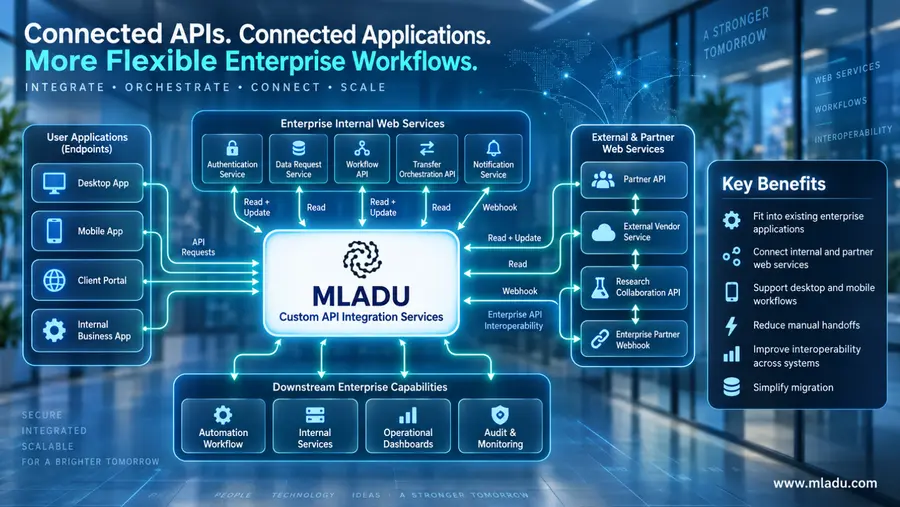
What Is Integration by Web Service?
A web service is an application interface exposed over a network so another system can request an action, submit information, or retrieve a result. Modern web services commonly use HTTP-based APIs and structured data formats.
In a transfer workflow, a web service may be used to request work, query status, exchange identifiers, coordinate data readiness, or communicate completion. Many enterprise and cloud-native applications are already composed of services that interact through APIs.
What Is Integration by Webhook?
A webhook is an event-driven callback in which one system sends an HTTP request to another system when a defined event occurs.
Instead of repeatedly asking whether something changed, a webhook can notify a receiving application that an event happened. This can be useful for transfer completion, exception conditions, approval changes, or downstream workflow activation when a supported event and secure receiving endpoint are available.
How Custom API Integration Can Reduce Manual Transfer Work
Without integration, users may need to copy information between systems, send email requests, monitor status manually, or update another application after a transfer completes.
A custom API integration can replace some of those handoffs with controlled system-to-system communication. For example, an internal application may initiate a workflow through an approved interface and later receive status that allows it to continue processing.
The exact approach depends on MLADU capabilities, customer APIs, authentication methods, network access, data sensitivity, rate limits, and support requirements.
When API Integration Is a Strong Fit
API and webhook patterns may be valuable when:
- The organization operates custom web applications or microservices
- Existing workflows already communicate through APIs
- Transfer initiation should be embedded in another application experience
- Downstream services need programmatic status or completion information
- A business process should continue automatically after data movement
- A legacy transfer platform is already called by an application
- Manual ticket, email, or copy-and-paste steps should be reduced
This approach is especially useful when data transfer is one stage inside a broader digital workflow.
Design APIs for Security and Operational Reliability
A production integration requires more than an endpoint.
Professional Services can help define authentication, authorization, network controls, request validation, correlation identifiers, timeouts, retries, idempotency, error responses, rate expectations, observability, secret management, and support ownership.
Webhook designs should also consider endpoint validation, replay protection, duplicate delivery, retry behavior, and what happens when the receiving system is unavailable.
Benefits of MLADU Professional Services for API Integration
MLADU Professional Services can help bridge platform knowledge with the customer's application architecture. This can shorten design time and reduce the risk of building an integration around incorrect assumptions.
The engagement can include architecture review, interface design, implementation support, test cases, negative testing, production launch coordination, and documentation for future operations and maintenance.
Frequently Asked Questions
What is web service integration?
It is system-to-system integration where applications communicate through network-accessible APIs to request actions, exchange information, or retrieve results.
What is a webhook?
A webhook is an event-driven HTTP callback that sends information to another system when a defined event occurs.
Can MLADU be integrated with custom applications that use APIs?
A customer-specific API integration can be evaluated and designed based on MLADU capabilities, the customer's interfaces, security requirements, and the intended workflow.
What should be considered in a production API integration?
Authentication, authorization, network security, validation, retries, idempotency, timeouts, error handling, observability, rate expectations, and support ownership should be defined.
Let's get started
Request a call with MLADU Concierge to discuss your APIs, web services, or webhook requirements. MLADU Professional Services can help identify a supportable pattern for connecting MLADU with the custom applications that already run your business or research workflows.
Topics
ON THIS PAGE
ASK A QUESTION
Can't find what you're looking for? Our team is here to help.


Try MLADU Free
Experience the power of AI powered data transfers.

No credit card required