A Secure, Scalable File Sharing Platform for Biotech Organizations
Biotechnology companies depend on collaboration.
Scientists exchange research data with laboratories. Clinical teams work with CROs. Bioinformatics groups move datasets between cloud environments. Research programs share data with universities, partners, consultants, and specialized vendors.
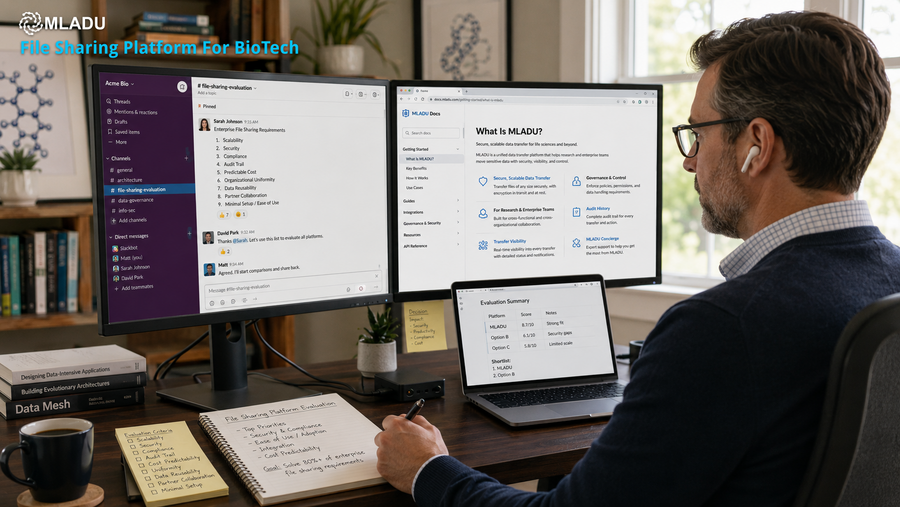
As the organization grows, so does the volume, sensitivity, and complexity of the data being exchanged.
At first, ordinary file-sharing tools may appear sufficient.
A researcher uploads data to a shared folder. Another team uses SFTP. A laboratory provides an Amazon S3 bucket. Someone creates a Box account. Another department maintains its own scripts and transfer procedures.
Individually, each solution works.
Organizationally, the result can become difficult to govern.
Biotech organizations eventually need more than a convenient place to upload files. They need a secure, scalable, governed file sharing platform capable of supporting large scientific datasets across the entire organization.
That is the problem MLADU is designed to solve.
MLADU provides a common managed data transfer platform that helps biotech organizations standardize how data is exchanged, improve security and auditability, control costs, coordinate complex transfers, and make valuable datasets easier to reuse across research programs.
Biotech File Sharing Becomes More Complicated as the Company Grows
A biotechnology company rarely has one simple data-sharing workflow.
Its ecosystem may include:
- Internal research teams
- Bioinformatics groups
- CROs
- Sequencing laboratories
- Imaging providers
- Academic collaborators
- Clinical sites
- CDMOs
- Consultants
- Cloud environments
- Data science teams
- Regulatory and quality personnel
- Strategic partners
Each group may use different technology.
A sequencing provider may deliver data through Amazon S3.
A CRO may use SFTP.
A research collaborator may use Box.
An internal analytics environment may operate in Microsoft Azure.
Another group may depend on Dropbox or an existing managed file transfer system.
Without a common organizational approach, each project can develop its own process.
That creates fragmentation.
MLADU provides biotech organizations with a common managed framework for moving data across these environments.
The Difference Between File Sharing and Managed Data Movement
Traditional file-sharing platforms are excellent for everyday collaboration.
They work well for:
- Documents
- Presentations
- Spreadsheets
- Small project files
- Team folders
- Routine office collaboration
Scientific data can be very different.
Biotech organizations routinely generate datasets involving:
- Genomics
- Sequencing
- Proteomics
- Imaging
- Microscopy
- Clinical research
- Bioinformatics
- Machine learning
- Biomarker research
- Preclinical studies
These datasets may contain hundreds of thousands or millions of files and can reach terabytes in size.
At that point, file sharing becomes an infrastructure problem.
Organizations must consider:
- Transfer scale
- Security
- Access
- Audit history
- Data ownership
- Approval
- Compliance
- Partner coordination
- Reliability
- Cost
- Reusability
MLADU combines managed file transfer capabilities with operational coordination and governance so these requirements can be addressed through a consistent organizational platform.
One File Sharing Strategy Across the Entire Biotech Organization
One of the greatest benefits of adopting MLADU is organizational uniformity.
Without a common platform, individual teams naturally develop their own approaches.
Research may use one service.
Clinical operations may use another.
A CRO relationship may rely on SFTP.
Bioinformatics may create custom scripts.
A laboratory may deliver data through a cloud bucket.
Over time, the organization can accumulate dozens of unrelated workflows.
Each workflow may have different:
- Security controls
- Credentials
- Approval processes
- Retention policies
- Audit capabilities
- Ownership models
- Transfer procedures
MLADU provides a common framework that can be applied across teams and programs.
The underlying data systems may remain different.
The governance surrounding data movement becomes consistent.
That is an important distinction.
MLADU does not require every collaborator to abandon the systems they already use. Instead, it provides a managed layer through which supported environments can participate in consistent transfer workflows.
Standardization Improves Governance
Imagine a growing biotech organization with six research programs.
Without centralization, those programs could develop six different approaches to external data sharing.
One may exchange credentials over email.
Another may maintain an SFTP server.
Another uses cloud storage links.
Another depends on a script written by an employee who has since left the company.
The problem is not simply technical inefficiency.
It becomes a governance problem.
MLADU helps organizations establish consistent practices for:
- Access
- Transfer execution
- Approvals
- Visibility
- Audit history
- Security
- Data handling
Instead of asking:
“How did this particular team transfer the data?”
leadership can establish an organizational answer:
“This is how our company manages external data movement.”
Scale Without Rebuilding Your Data Transfer Infrastructure
Biotechnology companies can grow very quickly.
A research-stage organization may begin with a handful of employees and a few collaborators.
Later, that same company may have:
- Multiple therapeutic programs
- Several CRO relationships
- Dozens of laboratories
- Clinical studies
- International partners
- Multiple cloud environments
- Large genomic or imaging datasets
The data transfer infrastructure must be able to grow with the company.
MLADU is designed for large-scale data movement.
The platform supports individual files up to 4 TB and can support individual transfer jobs involving 100 TB or more, subject to applicable platform and subscription requirements.
That means organizations do not have to replace their file-sharing strategy simply because datasets grow from gigabytes to terabytes.
The same managed approach can support increasingly complex data operations.
Scaling People Is Just as Important as Scaling Data
Data volume is only one dimension of growth.
The number of participants also increases.
A transfer that once involved two scientists may later involve:
- A data owner
- A CRO
- A laboratory
- A security administrator
- A cloud administrator
- A project manager
- A transfer approver
- A recipient
- A quality representative
MLADU supports role-based responsibilities so the platform can accommodate more sophisticated governance as the organization matures.
That allows a biotech company to increase operational control without replacing the underlying transfer platform every time its organizational structure changes.
Control Data Transfer Costs as the Organization Expands
Scaling infrastructure can become expensive.
Organizations may attempt to solve data transfer requirements by adding:
- Servers
- Storage
- Commercial MFT software
- Monitoring tools
- Security products
- Custom integrations
- Additional administrators
- Cloud engineering resources
- Support personnel
The software license is only one component of the cost.
Internal labor can become much more expensive.
Someone must configure the environment.
Someone must monitor it.
Someone must update it.
Someone must maintain scripts.
Someone must respond when transfers fail.
Someone must coordinate external partners.
MLADU uses a SaaS subscription model that allows organizations to approach data transfer as a more predictable operating expense rather than continually building additional infrastructure.
For growing biotechnology organizations, predictability matters.
Leadership can allocate more capital to research, clinical development, hiring, and product milestones instead of repeatedly expanding transfer infrastructure.
Make Security Consistent Across Every Team
Biotechnology data is valuable.
It may include:
- Proprietary research
- Genomic information
- Clinical data
- Intellectual property
- Biomarker datasets
- Preclinical results
- Drug development information
Allowing each department to develop its own transfer practices makes consistent security difficult.
MLADU provides a common security foundation.
Platform capabilities include:
- TLS 1.2 or greater for data in transit
- AES-256 encryption for data at rest
- Multi-factor authentication and identity controls
- Role-based access
- Dedicated customer environments
- Web application firewall protections
- Detailed transfer activity history
Instead of requiring every project team to assemble its own controls, the organization can apply a more consistent security approach across managed transfers.
Make Compliance Easier to Manage
Compliance becomes significantly more difficult when data movement is fragmented.
Different departments may maintain different records.
Some transfers may have detailed logs.
Others may only have email correspondence.
Some external collaborators may have structured access procedures.
Others may rely on informal processes.
MLADU helps centralize transfer-related activity so organizations can apply more consistent governance across teams.
This can help support:
- Internal compliance programs
- Quality processes
- Security reviews
- Research governance
- HIPAA-related obligations where applicable
- GDPR-related obligations where applicable
- GxP-related processes where applicable
- Partner requirements
- Internal policies
MLADU provides technical and operational controls that can support these responsibilities. Organizations remain responsible for determining the regulatory and compliance requirements applicable to their particular data and workflows.
Auditability Should Not Require an Investigation
Suppose someone asks six months after a transfer:
Who sent this dataset?
Then:
Who received it?
Who approved it?
When did it move?
Did it complete successfully?
Who had access?
If transfers are distributed across multiple platforms, those answers may require searching:
- Support tickets
- Cloud logs
- Scripts
- SFTP logs
- Spreadsheets
- Chat messages
MLADU maintains centralized transfer history and operational visibility.
This creates a much clearer record of transfer-related activity.
For quality, security, compliance, and research governance teams, that can turn an investigation into a routine lookup.
Better Data Sharing Can Improve Data Reusability
One of the most valuable assets a biotech organization owns is its data.
Unfortunately, data that has already been generated is not always easy to reuse.
A research dataset may have been transferred to a specific scientist for one project.
Another team later discovers that the same dataset could support:
- A new biomarker study
- A machine learning project
- A retrospective analysis
- A different therapeutic program
- Validation research
- A collaboration with another institution
But first, the organization must determine:
Where is the dataset?
Who owns it?
Who previously received it?
Can it be transferred again?
How was it originally moved?
A more centralized data transfer strategy improves organizational knowledge about valuable datasets.
When approved datasets and their transfer activities can be managed through a consistent platform, organizations create better foundations for downstream reuse.
MLADU therefore provides value beyond moving data once.
It helps create a more reusable data ecosystem.
Move Once. Reuse Many Times.
Consider a 25 TB sequencing dataset.
The organization initially transfers it for one research program.
Six months later, another group wants to analyze the same dataset using a new computational model.
Later, an external collaborator needs an approved subset.
With fragmented transfer processes, every request may become a new operational project.
With a consistent managed platform, the organization has a clearer framework for governing subsequent movement and reuse.
That can improve the return on investment from scientific data that may have been extremely expensive to generate.
MLADU Concierge Handles the Coordination
Technology is only part of data sharing.
Coordination is frequently the harder problem.
A biotech data transfer can involve:
- A scientist requesting data
- A laboratory producing it
- A CRO managing the project
- An external IT department
- A cloud administrator
- A data owner
- A security team
- A receiving organization
Someone must coordinate them.
MLADU Concierge can help customers organize and execute complex transfers.
This helps reduce the operational burden on internal teams.
Scientists do not have to become transfer project managers.
Operations teams do not have to chase multiple external organizations for technical details.
MLADU provides both the platform and the human coordination that can help move the process forward.
Minimal Setup Makes Standardization Easier
Organizational standards only work when people actually use them.
If the approved file-sharing platform requires weeks of configuration every time a new collaborator is added, teams may find workarounds.
MLADU is delivered as SaaS and is designed to minimize infrastructure setup.
That makes it easier to establish MLADU as the organization's preferred approach for large or sensitive data exchange.
A centralized strategy becomes practical rather than bureaucratic.
Connect the Platforms Your Biotech Ecosystem Already Uses
Biotechnology collaboration rarely occurs within one technology ecosystem.
MLADU supports data movement across platforms and protocols including:
- Amazon S3
- Microsoft Azure Blob Storage
- Box
- Dropbox
- SFTP
- FTPS
- GoAnywhere
- Supported on-premises environments
- Other supported SaaS and cloud systems
That means organizations can standardize the transfer process without demanding that every CRO, laboratory, university, or collaborator migrate to the same storage platform.
This is especially useful for biotech organizations with diverse partner ecosystems.
MLADU From Every Organizational Perspective
The value of an enterprise biotech file-sharing platform looks different depending on who is using it.
For Scientists
Scientists gain a clearer way to request, receive, and exchange research datasets without becoming infrastructure administrators.
They can spend more time analyzing data and less time troubleshooting transfers.
For Research Leadership
Research leaders gain a scalable platform that can support multiple programs without each team creating independent transfer processes.
For IT
IT gains a standardized managed approach instead of maintaining an expanding collection of scripts, servers, credentials, and transfer tools.
For Security
Security teams gain more consistent access controls, encryption, visibility, and activity history.
For Compliance and Quality
Compliance teams gain greater consistency and traceability surrounding data movement.
For Operations
Operations teams gain centralized transfer management and Concierge assistance for coordinating external parties.
For Finance and Leadership
Executives gain more predictable costs and reduce the need for continual infrastructure expansion.
For Data Science Teams
Data science groups benefit from an environment that makes valuable datasets easier to discover operationally, transfer again, and reuse across approved workflows.
MLADU Versus Generic File Sharing
| Requirement | Generic File Sharing | MLADU |
|---|---|---|
| Everyday documents | Excellent | Supported where appropriate |
| Large scientific datasets | May become difficult | Designed for large data movement |
| Terabyte-scale transfers | Often limited | Designed for TB-scale workflows |
| Cross-platform transfers | Often requires manual work | Supported across multiple platforms |
| Organizational governance | Varies by team | Central managed framework |
| Transfer approvals | Often limited | Role-based workflow options |
| Detailed audit history | Varies | Central transfer activity history |
| External partner coordination | Customer responsibility | Concierge assistance available |
| Security controls | Depends on platform and configuration | Integrated security controls |
| Compliance support | Fragmented across tools | More consistent organizational framework |
| Cost predictability | Can expand across multiple systems | Subscription-based model |
| Dataset reuse | Often siloed | Supports a more reusable data ecosystem |
When Should a Biotech Organization Consider MLADU?
MLADU may be a strong fit when your organization:
- Regularly exchanges data with CROs, laboratories, or research partners
- Has multiple teams using different file transfer approaches
- Is generating genomic, imaging, clinical, or other large datasets
- Needs to move terabytes of data
- Wants consistent security across the organization
- Needs better auditability
- Wants to establish organization-wide transfer policies
- Needs predictable data transfer costs
- Wants to reduce custom transfer scripts and infrastructure
- Wants external coordination assistance
- Wants valuable datasets to be easier to reuse across research programs
- Expects data volume and collaboration complexity to grow
Frequently Asked Questions
What is the best file sharing platform for biotech organizations?
Biotech organizations should look for a file sharing platform that can securely move large research datasets, scale across teams and partners, provide strong access controls and auditability, support compliance requirements, and centralize data operations. MLADU is designed for biotech organizations that need enterprise-grade data transfer and sharing without building a complex internal infrastructure.
How is MLADU different from traditional file sharing platforms?
Traditional file sharing tools are often optimized for documents and everyday collaboration. MLADU is designed for large, sensitive, and operationally important datasets. It combines managed file transfer, role-based access, audit history, cross-platform connectivity, transfer visibility, workflow controls, and Concierge support.
Can MLADU scale as a biotech company grows?
Yes. MLADU is designed to support growing data volumes, more users, additional partners, and increasingly complex transfer workflows. Organizations can use the same managed platform as their research, clinical, laboratory, and partner ecosystems expand.
How does MLADU help biotech companies control file transfer costs?
MLADU helps organizations reduce the need to build and operate separate transfer infrastructure, maintain custom scripts, and dedicate internal staff to routine transfer coordination. Its subscription model gives organizations a more predictable way to budget for managed data movement.
How does MLADU support security for biotech data sharing?
MLADU provides security controls including TLS 1.2 or greater for data in transit, AES-256 encryption at rest, role-based access, authentication controls, dedicated client environments, web application firewall protections, and detailed audit history.
How does MLADU help with compliance and audit requirements?
MLADU centralizes transfer activity, permissions, approvals, and audit history so organizations can more consistently govern data movement across teams and partners. This helps support internal compliance, security review, quality, and audit processes.
Can MLADU create consistent file sharing policies across an organization?
Yes. MLADU provides a common managed transfer framework that organizations can use across departments, programs, researchers, and external collaborators. This helps reduce inconsistent local practices and supports more uniform security, governance, and operational controls.
How can MLADU improve data reusability?
By managing datasets and transfer activity through a common platform, organizations can improve visibility into data movement and create more consistent processes for accessing, transferring, and reusing approved datasets across research programs, collaborators, and downstream workflows.
Can MLADU coordinate data transfers with CROs, laboratories, and research partners?
Yes. MLADU Concierge can help coordinate transfer requirements among internal teams, CROs, laboratories, research institutions, data owners, cloud administrators, and other authorized participants.
What systems can MLADU connect to?
MLADU supports data movement across platforms and protocols including Amazon S3, Microsoft Azure Blob Storage, Box, Dropbox, SFTP, FTPS, GoAnywhere, and other supported cloud, SaaS, and on-premises environments.
Is MLADU suitable for large biotech datasets?
Yes. MLADU is designed for large research and enterprise datasets. It supports files up to 4 TB and can support single transfer jobs involving 100 TB or more, subject to applicable platform and subscription requirements.
One Platform for the Data Behind Your Science
As biotechnology organizations grow, file sharing should not become more fragmented.
More research programs should not mean more scripts.
More partners should not mean more unmanaged credentials.
More data should not mean less visibility.
And stronger governance should not require scientists to spend more time administering technology.
MLADU gives biotechnology organizations a common platform for securely moving large datasets across teams, systems, and external partners while maintaining greater consistency around cost, security, compliance, auditability, and operational processes.
The result is not simply better file sharing.
It is a more scalable way to manage the movement and reuse of the data that drives the organization.
Share the data. Govern the process. Reuse the science.
Topics
ON THIS PAGE
ASK A QUESTION
Can't find what you're looking for? Our team is here to help.


Try MLADU Free
Experience the power of AI powered data transfers.

No credit card required