MLADU Migration Decommission Services
The financial and operational benefits of migration are often realized only after the old environment is reduced or retired. MLADU Migration Decommission Services help organizations safely scale back or shut down legacy data transfer platforms and integrations after the new MLADU production state has been validated.
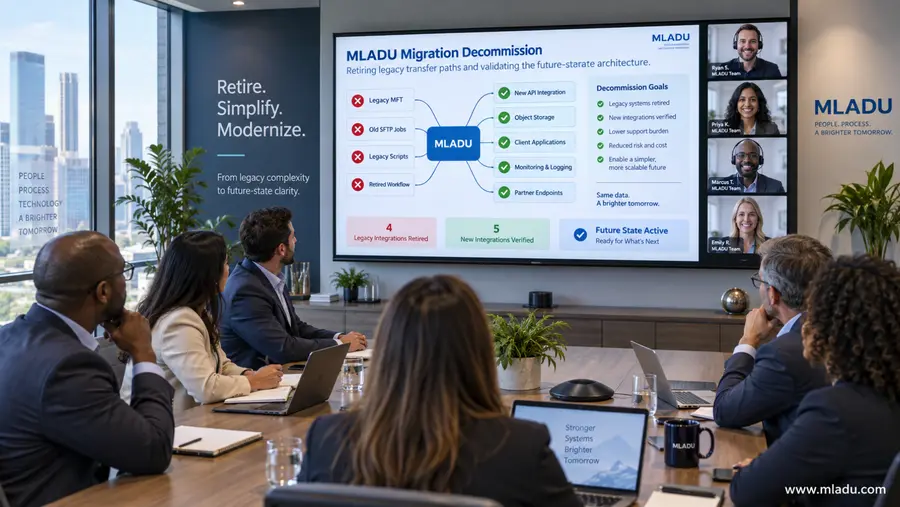
What Is Decommission in the Context of MLADU?
Decommission is the controlled process of reducing, disabling, or retiring legacy transfer platforms, infrastructure, integrations, and operating processes that are no longer required after migration to MLADU.
It is intentionally performed after the organization has validated the new production state. The objective is to remove unnecessary cost and risk without accidentally eliminating a dependency that is still needed.
Why Legacy Transfer Systems Often Remain Too Long
Organizations frequently keep old systems running “just in case.”
That caution is understandable during migration, but temporary overlap can become permanent. The organization may continue paying license fees, maintaining servers, renewing certificates, patching software, monitoring old jobs, and supporting credentials for a platform that is no longer part of the intended future state.
Over time, people may forget why the legacy system still exists, which makes it even harder to retire.
What Decommission Work May Include
Depending on the environment, decommission activities may include:
- Confirming that required transfers have moved to MLADU
- Verifying legacy integrations are no longer needed
- Disabling schedules, scripts, jobs, queues, or automated triggers
- Revoking or rotating credentials and service accounts
- Removing firewall rules or network paths no longer required
- Archiving required logs, configuration, or audit evidence
- Removing unused servers or cloud resources
- Ending unnecessary software licenses or support agreements
- Updating monitoring and alerting
- Updating architecture and compliance documentation
- Communicating the retirement to stakeholders
- Confirming ownership of any legacy components that must remain
The decommission scope should reflect organizational retention, security, legal, compliance, and operational requirements.
Scale Back Before Shutting Down When Appropriate
Decommission does not always need to be a single shutdown event.
An organization may first reduce the legacy platform to a smaller role, remove migrated workflows, observe the remaining activity, and then retire additional components. This staged approach can provide evidence that the old system is no longer required.
Professional Services can help define exit criteria so the organization knows what must be true before each legacy component is disabled.
Decommission Is Part of the Migration Business Case
If a legacy platform remains fully operational indefinitely, the organization may end up paying for both the old and new states.
A planned decommission helps capture the intended benefits of modernization by reducing duplicated infrastructure, support effort, maintenance, licensing, credentials, operational procedures, and security surface area.
It can also simplify audits and incident response because fewer transfer paths remain active.
Benefits of MLADU Professional Services for Decommission
The resources who supported assessment, migration, and launch may already understand which legacy components were replaced and what evidence was collected during validation.
That continuity can help the organization decommission with greater confidence. Professional Services can assist with dependency verification, shutdown planning, coordination, documentation, and confirmation that the intended future state remains operational after legacy components are removed.
Frequently Asked Questions
What is MLADU migration decommission?
It is the controlled process of scaling back or retiring legacy data transfer platforms, infrastructure, integrations, credentials, and operating processes after the MLADU future state has been validated.
Why not shut down the legacy platform immediately after launch?
The organization should first confirm that required workflows, integrations, support processes, and evidence are operating successfully in the new production state.
Can decommission be performed in stages?
Yes. Organizations may progressively reduce the legacy platform and use defined exit criteria before retiring additional components.
What are the benefits of decommissioning legacy transfer systems?
Benefits can include lower licensing and infrastructure cost, less maintenance, fewer credentials and attack surfaces, simpler operations, clearer architecture, and reduced support burden.
Let's get started
Request a call with MLADU Concierge to discuss legacy transfer decommission. MLADU Professional Services can help your organization move beyond parallel operation and safely reduce or retire the systems, integrations, and costs that MLADU has replaced.
Topics
ON THIS PAGE
ASK A QUESTION
Can't find what you're looking for? Our team is here to help.


Try MLADU Free
Experience the power of AI powered data transfers.

No credit card required