Why Research Data Sharing Is Becoming a Governance Problem Instead of a Technology Problem
Research Collaboration Has Never Been Easier… Or More Complex
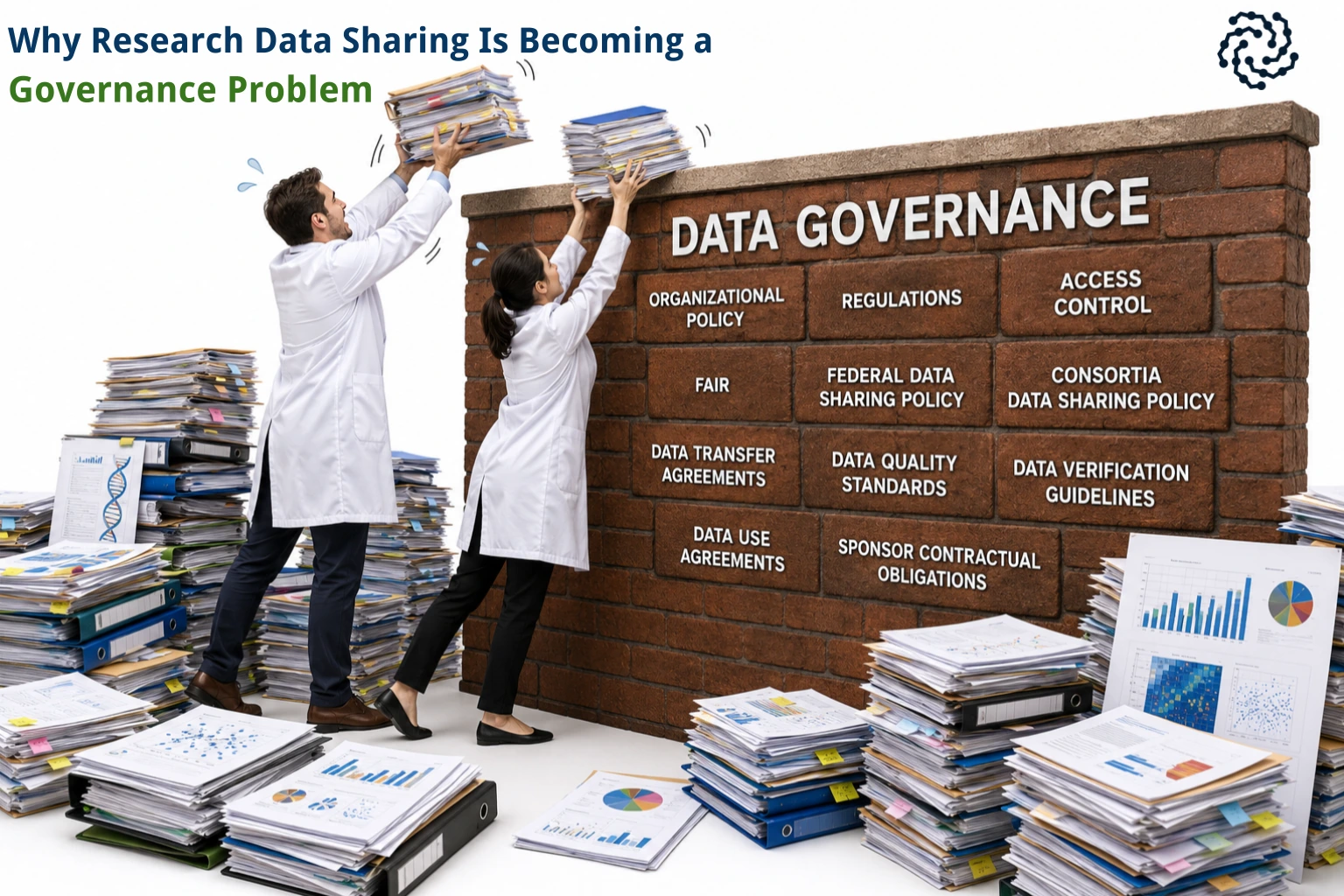
Modern research depends on collaboration.
Universities partner with hospitals.
Biopharmaceutical companies collaborate with academic researchers.
Government agencies fund international consortiums.
Clinical trial sites exchange data across multiple countries.
Cloud platforms make it possible to store research data almost anywhere in the world.
From a technology perspective, sharing data has become easier than ever.
From a governance perspective, it has become significantly more complicated.
Today, the greatest challenge facing many research organizations is no longer whether they can transfer data.
It is whether they can demonstrate that the data was transferred securely, responsibly, and according to policy.
The Questions Researchers Are Being Asked Have Changed
Research leaders increasingly encounter questions that have very little to do with network speed or storage capacity.
Instead, they are asked:
- Who approved this data transfer?
- Who uploaded the dataset?
- Who downloaded it?
- Which version of the data was shared?
- Was patient data protected?
- Can the organization demonstrate compliance?
- Is there a complete audit trail?
- Can the transfer be reproduced during an audit?
These questions originate from research sponsors, institutional review boards, funding agencies, security teams, privacy offices, and consortium governance committees.
Answering them has become just as important as completing the transfer itself.
The Rise of Research Data Governance
Research data governance refers to the policies, processes, and technologies that help ensure research data is handled responsibly throughout its lifecycle.
Effective governance helps organizations:
- Protect sensitive research data.
- Define who may access specific datasets.
- Document approvals before data is shared.
- Maintain complete records of transfer activity.
- Demonstrate compliance during audits.
- Support responsible collaboration across institutions.
Organizations such as the National Institutes of Health (NIH) have increasingly emphasized responsible data management and sharing through the NIH Data Management and Sharing Policy, which encourages researchers to plan how scientific data will be managed, preserved, and shared throughout the research lifecycle.
Similarly, the widely adopted FAIR Guiding Principles for Scientific Data Management and Stewardship encourage research data to be Findable, Accessible, Interoperable, and Reusable while recognizing that accessibility must be balanced with appropriate governance and security.
The objective is not simply to share more data.
It is to share data responsibly.
Why Governance Has Become More Difficult
Several trends have dramatically increased governance complexity.
Research Is More Collaborative
A single research study may involve:
- Universities
- Academic medical centers
- Government agencies
- Pharmaceutical companies
- Biotechnology organizations
- Contract research organizations
- International collaborators
Each participant operates under different security policies, institutional procedures, and regulatory obligations.
Research Data Is Larger Than Ever
Modern research routinely generates:
- Genomic sequencing data
- Digital pathology images
- Medical imaging
- Multi-omics datasets
- AI training data
- Clinical research data
Larger datasets often require multiple storage systems and cloud providers, making governance more challenging than simply emailing files or using consumer-grade file sharing services.
Regulatory Expectations Continue to Grow
Research organizations increasingly operate within frameworks that emphasize secure data stewardship, privacy, accountability, and reproducibility.
Examples include:
- NIH Data Management and Sharing Policy
- Institutional Review Board (IRB) requirements
- Consortium Data Use Agreements
- HIPAA privacy and security requirements for protected health information, where applicable
- GDPR requirements for organizations handling personal data in the European Union
- Sponsor-specific contractual obligations
Each introduces additional governance responsibilities throughout the data sharing process.
Governance Is About More Than Security
Many people equate governance with cybersecurity.
Security is certainly important, but governance extends much further.
Effective governance also includes:
Defined Ownership
Every dataset should have a clearly identified owner responsible for approving its distribution.
Controlled Access
Not every collaborator requires identical permissions.
Different researchers may need to:
- Upload data
- Review requests
- Approve transfers
- Download datasets
- Audit historical activity
Role-based access reduces unnecessary risk while supporting efficient collaboration.
Approval Workflows
Many organizations require data transfers to receive formal approval before they occur.
Approval workflows help ensure:
- Correct datasets are shared.
- Appropriate collaborators receive access.
- Institutional policies are followed consistently.
Complete Audit History
Perhaps the most important governance capability is maintaining a complete record of what occurred during every transfer.
Organizations should be able to answer questions such as:
- Who initiated the transfer?
- Who approved it?
- When did it begin?
- When did it complete?
- Was it successful?
- Were there any failures?
- Who downloaded the data?
- Were notifications sent?
- Were permissions modified?
Comprehensive audit histories improve transparency while simplifying internal reviews and external audits.
Governance Enables Better Science
Governance is sometimes viewed as administrative overhead.
In reality, effective governance accelerates research.
When researchers trust the systems that manage data sharing, they spend less time coordinating approvals, searching through email threads, and reconstructing transfer histories.
Instead, they can focus on:
- Scientific discovery
- Clinical research
- Data analysis
- Collaboration
- Publication
Strong governance creates confidence across research teams, institutions, and funding organizations.
How MLADU Simplifies Research Data Governance
MLADU was designed specifically for research organizations that must exchange large datasets while maintaining visibility, accountability, and control.
Instead of relying on disconnected tools, MLADU combines secure data transfer with governance capabilities that support modern research collaboration.
MLADU helps organizations:
- Securely transfer large research datasets across cloud and on-premises environments.
- Define role-based permissions for researchers, administrators, and data owners.
- Support transfer approval workflows before data is exchanged.
- Maintain comprehensive audit histories of transfer activity.
- Provide transfer visibility from initiation through completion.
- Protect data using encrypted communications and secure storage.
- Enable collaboration across universities, hospitals, biopharmaceutical companies, and research consortiums.
The result is a governed data-sharing environment that reduces administrative burden while strengthening confidence in every transfer.
Governance Is Becoming a Competitive Advantage
Research is becoming increasingly collaborative, distributed, and data intensive.
Organizations that invest in governed data sharing are better positioned to:
- Accelerate collaboration.
- Improve reproducibility.
- Demonstrate accountability.
- Simplify compliance activities.
- Build trust among consortium partners.
- Prepare for future regulatory expectations.
Technology alone no longer solves research data sharing.
Successful organizations combine speed with governance, security with accountability, and collaboration with transparency.
The future of research belongs to organizations that can move data and prove they managed it responsibly.
References
The following resources provide additional guidance on research data governance, data sharing, and responsible stewardship:
- NIH Data Management & Sharing Policy
- NIH Office of Data Science Strategy
- FAIR Guiding Principles for Scientific Data Management and Stewardship (Nature Scientific Data)
- GO FAIR Initiative
- HIPAA Security Rule Summary (U.S. Department of Health & Human Services)
- European Commission GDPR Overview
Topics
ON THIS PAGE
ASK A QUESTION
Can't find what you're looking for? Our team is here to help.


Try MLADU Free
Experience the power of AI powered data transfers.

No credit card required