MLADU Data Set Categories
Organize, Share, Reuse, and Monetize Data With Greater Control
Your organization's data is valuable. But how much value does it deliver when the people who need it cannot discover, access, or reuse it?
Across healthcare, life sciences, biotechnology, research institutions, and commercial enterprises, organizations invest significant resources collecting, generating, cleaning, validating, and maintaining data.
Unfortunately, valuable data often remains isolated within departments, cloud storage environments, research laboratories, and organizational boundaries.
The result? Teams recreate existing data, researchers repeat work, collaboration slows, and organizations miss opportunities to maximize the return on their data investments.
MLADU Data Set Categories help change that.
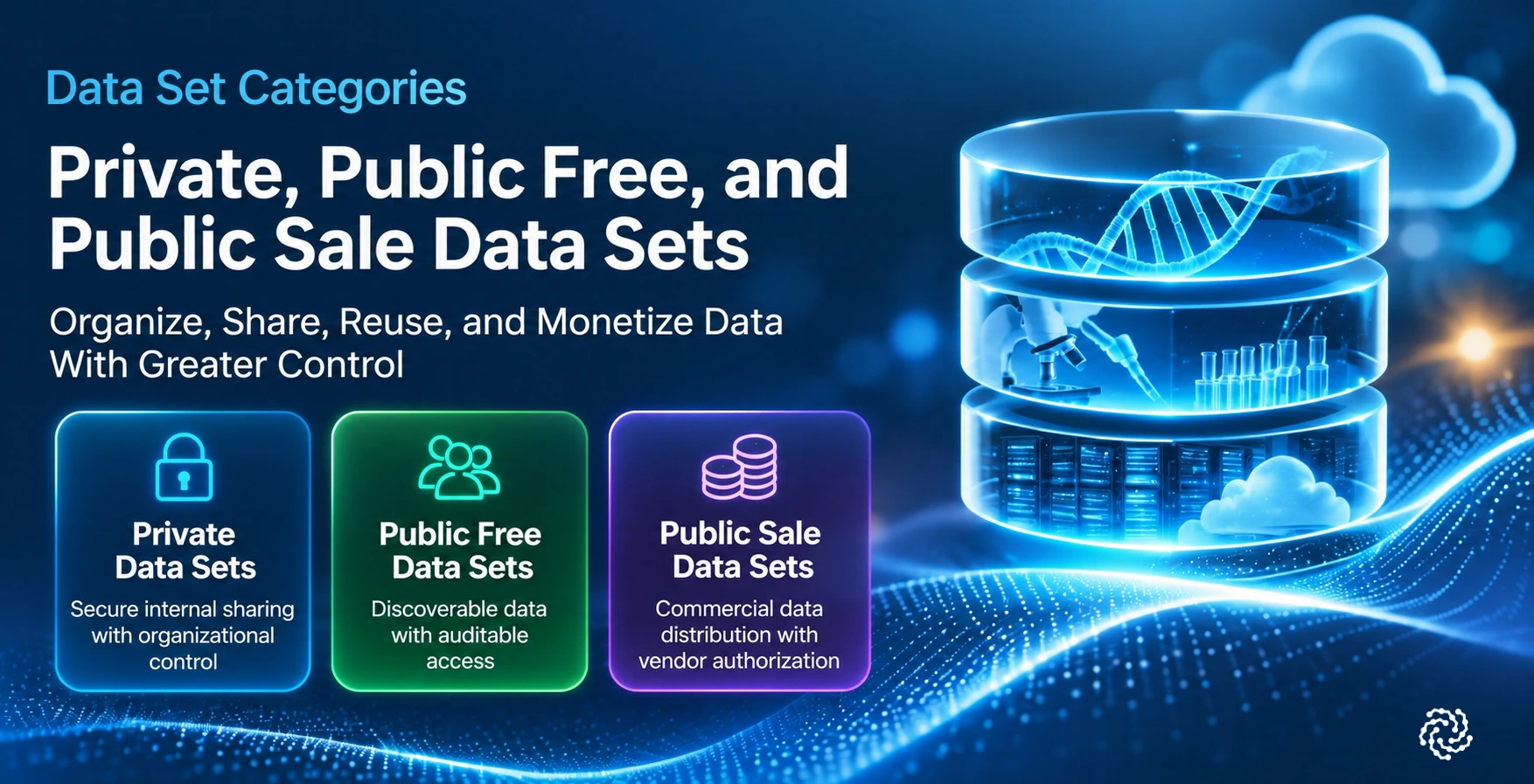
MLADU provides three distinct categories for organizing and distributing data:
- Private Data Sets: Governed data sharing within an organization and approved transfers outside its boundaries.
- Public Free Data Sets: Discoverable, freely available data distributed to known MLADU users with auditable transfer activity.
- Public For Sale Data Sets: Discoverable commercial data offerings distributed through vendor-authorized, concierge-enabled transfers.
Whether your organization needs to protect sensitive research data, distribute public scientific datasets, or establish a commercial data distribution strategy, MLADU provides a structured way to make data more useful, accessible, and accountable.
What Are MLADU Data Set Categories?
MLADU Data Set Categories define how an organization makes a Data Set available to its intended audience.
A MLADU Data Set is a uniquely identifiable reference to a collection of data located at a MLADU Data Station. It provides descriptive information that helps users discover and select the correct data without navigating complex cloud storage structures or technical file paths.
A Data Station defines how MLADU connects to a storage environment. A Data Set defines the collection of data users want to access or transfer.
Data Set Categories add another important dimension: how that collection can be discovered, shared, and distributed.
Rather than treating every data collection the same way, organizations can establish appropriate sharing models based on the intended audience, governance requirements, and commercial objectives.
Three Categories. One Governed Data Exchange Platform.
| Category | Intended Audience | Distribution Model |
|---|---|---|
| Private Data Sets | Authorized users within the owning organization | Internal transfers and approval-controlled external transfers |
| Public Free Data Sets | Known MLADU users with access to the associated Data Station | Freely available data with auditable access and transfer activity |
| Public Sale Data Sets | Known MLADU users with access to the associated Data Station | Commercial data distribution requiring vendor authorization and concierge enablement |
All three categories help organizations maintain clear Data Set definitions, improve discoverability, and establish more consistent data distribution processes.
Private Data Sets: Secure Internal Data Sharing With Organizational Control
Keep Sensitive Data Private Without Limiting Collaboration
Not every Data Set should be available outside an organization.
Clinical research records, proprietary scientific findings, financial information, intellectual property, and internal operational data often require carefully controlled access.
MLADU Private Data Sets allow organizations to maintain control over their data while supporting efficient internal transfers and authorized external collaboration.
Private Data Sets are available only to authorized users within the organization's own MLADU Client Portal.
Authorized users can transfer these Data Sets within their organization. Transfers outside the organization are governed by the organization's configured approval requirements.
This creates a practical balance between data accessibility and organizational oversight.
Why Private Data Sets Matter
Protect valuable information. Keep proprietary and sensitive Data Sets within the organization's authorized user environment.
Enable internal data reuse. Allow approved teams to discover and transfer existing data rather than generating unnecessary duplicate collections.
Support controlled external collaboration. Configure approval workflows for transfers to external research partners, vendors, sponsors, or other organizations.
Improve accountability. Maintain visibility into transfer activity and Data Set management through MLADU's audit capabilities.
Reduce operational friction. Give authorized users a consistent way to identify and transfer data without repeatedly coordinating technical storage details.
Example: Reusing Genomics Data Across Research Teams
Imagine a biotechnology company that generates a 25 TB genomics Data Set for a drug discovery program.
The sequencing team completes its analysis, but the same data may also be valuable to:
- Bioinformatics researchers studying additional genetic variants
- AI teams developing predictive models
- Translational scientists investigating new biomarkers
- Clinical research teams preparing subsequent studies
Without a shared Data Set catalog, these teams may not realize the data already exists.
By defining the collection as a Private Data Set in MLADU, the organization gives authorized users a consistent reference for discovering and transferring the data.
One valuable data collection can support multiple research objectives without requiring each team to start from scratch.
If an approved external research partner needs the data, the organization can apply its configured transfer approval process before distribution.
Public Free Data Sets: Make Valuable Data Discoverable, Reusable, and Auditable
Freely Available Data Should Still Have Accountable Distribution
Making data freely available does not mean an organization should lose visibility into its distribution.
Research institutions, government programs, nonprofit organizations, scientific consortiums, and commercial enterprises frequently publish data for the benefit of broader communities.
However, traditional public download approaches may provide limited information about who receives the data.
MLADU Public Free Data Sets combine broad data availability with known-user accountability.
Any MLADU user who has access to the associated public Data Station can access its Public Free Data Sets.
Unlike anonymous download models, users accessing Public Free Data Sets must be known individuals within MLADU.
This allows organizations to distribute freely available data while maintaining auditable transfer records associated with identified users.
Why Public Free Data Sets Matter
Expand scientific collaboration. Make approved research collections available to a broader community without requiring individual commercial transactions.
Encourage data reuse. Help researchers discover existing data that can support new studies, validation efforts, and secondary analyses.
Improve distribution accountability. Maintain an auditable record of transfers to known MLADU users.
Support FAIR data practices. Improve the findability, accessibility, and reusability of research data through descriptive Data Set definitions and governed access.
Reduce repetitive distribution work. Establish reusable Data Set references instead of coordinating each new data request through disconnected manual processes.
Increase the value of funded research. Help more researchers benefit from data that requires substantial time and resources to produce.
Example: A Rare Disease Research Consortium
Imagine a rare disease research consortium that has assembled a 40 TB collection of approved genomic and clinical research data.
The consortium wants qualified research teams around the world to benefit from the data.
Instead of distributing files through unrelated download links, email requests, and manually managed transfer processes, the consortium can publish an approved collection as a Public Free Data Set.
Researchers who are known MLADU users and have access to the associated Data Station can discover and transfer the collection.
The consortium benefits from an auditable distribution process, while researchers gain a consistent way to access the published data.
This approach can support:
- Independent scientific validation
- Reproducibility studies
- Secondary research
- Cross-institutional collaboration
- AI and machine learning research
- New hypotheses derived from existing data
The original research investment continues generating value long after the first study is complete.
Public Free Data Sets are especially useful for approved open-science initiatives, public research repositories, educational collections, and scientific reference datasets.
Importantly, organizations should only publish information they are authorized to distribute freely. Public Free categorization does not replace required consent, privacy, licensing, or other data governance obligations.
Public for Sale Data Sets: Turn Valuable Data Into Commercial Opportunities
Discoverable Data. Vendor-Controlled Sales. Auditable Distribution.
Many organizations possess valuable data collections that other organizations are willing to purchase.
Examples include curated scientific datasets, commercial reference collections, licensed imaging data, proprietary analytical outputs, and specialized industry information.
But commercial data distribution presents challenges.
How can potential buyers discover available datasets? How can vendors control distribution? How can organizations maintain an auditable record of what was transferred and to whom?
MLADU Public Sale Data Sets provide a structured way to advertise data availability and facilitate vendor-authorized commercial data transfers.
Organizations can designate a Data Set as Public for Sale, making its for-sale status visible to known MLADU users who have access to the associated public Data Station.
The data vendor retains responsibility for the commercial transaction and determines when distribution is authorized.
How Public Sale Data Sets Work
Step 1: Publish a Data Set for Sale
The selling organization defines a Data Set and designates it as Public for Sale.
Known MLADU users with access to the associated public Data Station can discover the offering and see that the data is available for purchase.
Step 2: Complete the Commercial Arrangement
The interested buyer works directly with the data vendor to complete the applicable purchase, licensing, or other commercial agreement.
MLADU does not process payments or manage the commercial transaction.
Step 3: Authorize the Data Transfer
Once the data vendor approves the sale and authorizes distribution, the selling organization notifies MLADU Concierge.
Step 4: Concierge Enables the Approved Transfer
MLADU Concierge enables the data transfer for a single use based on the vendor's authorization.
Each additional authorized sale transfer requires its own enablement.
Step 5: Maintain an Auditable Transfer Record
MLADU's transfer audit capabilities provide a record of the authorized distribution, supporting operational accountability and data delivery verification.
Why Public for Sale Data Sets Matter
Create new revenue opportunities. Offer valuable, appropriately licensed datasets to organizations that can benefit from them.
Retain commercial control. Keep payment processing, licensing terms, pricing, and buyer agreements under the data vendor's management.
Improve buyer discovery. Present available commercial Data Sets through a structured, searchable organizational data catalog.
Support controlled fulfillment. Require vendor authorization and single-use Concierge enablement for each approved commercial transfer.
Strengthen delivery accountability. Use MLADU's manifests, verification, and audit capabilities to support evidence of data distribution.
Monetize existing data investments. Create opportunities for curated and validated data to generate value beyond its original intended purpose.
Example: A Commercial Genomics Data Provider
Imagine a genomics company that has invested millions of dollars generating, curating, and validating a specialized 15 TB genomic reference dataset.
The collection may be valuable to pharmaceutical companies, biotechnology organizations, academic research groups, and AI developers.
Instead of building and maintaining a custom commercial data delivery platform, the provider can publish the offering as a MLADU Public for Sale Data Set.
A prospective buyer discovers the collection and negotiates a licensing agreement directly with the provider.
After the commercial agreement is completed, the vendor authorizes the transfer through MLADU Concierge.
Concierge enables the approved one-time transfer, and MLADU provides the data movement and associated audit capabilities.
The same underlying dataset may be licensed to multiple authorized buyers over time, subject to the vendor's rights and agreements.
The data provider can focus on creating valuable data products while MLADU helps manage their controlled distribution.
How Data Set Categories Improve Organizational Data Reusability
Data Becomes More Valuable When It Can Be Used More Than Once
One of the most expensive problems in enterprise data management is not necessarily storing data.
It is failing to reuse data that already exists.
Organizations routinely invest in data acquisition, scientific experiments, sequencing, imaging, cleansing, validation, and preparation.
When the resulting data remains difficult to find or access, its potential value is limited.
MLADU Data Set Categories help address this problem by making reusable data collections easier to identify and distribute through appropriate governance models.
Five Ways Data Set Categories Encourage Reuse
- Improve discoverability. Descriptive Data Set names, unique identifiers, and metadata help users find existing collections instead of recreating them.
- Establish consistent references. Teams can refer to the same defined Data Set rather than relying on inconsistent folder names, storage paths, or informal descriptions.
- Make sharing expectations clear. Private, Public Free, and Public Sale categories communicate the intended distribution model.
- Reduce barriers to collaboration. Authorized users can identify relevant data and follow established transfer processes rather than starting a new technical integration for every exchange.
- Extend the useful life of data. Existing collections can support additional research, analytics, AI development, external collaboration, or commercial distribution.
Example: One Data Set, Multiple Business Outcomes
A pharmaceutical company creates a curated imaging dataset for an oncology research program.
Initially, the collection is maintained as a Private Data Set.
Later, the organization identifies additional approved uses:
- Internal AI researchers reuse the images for model evaluation.
- Clinical scientists reuse the data for a secondary analysis.
- An external research partner receives an approved transfer.
- A separately authorized and appropriately prepared research collection is made available for public scientific use.
- A commercially licensable collection may be offered through a Public Sale arrangement.
Each use can create additional value from the organization's underlying data investment.
The objective is not to make all data public. It is to make valuable data reusable under the right conditions.
Better Data Reusability Can Improve Data Quality
Reusable Data Encourages Better Data Stewardship
When data is collected for a single purpose and then forgotten, quality problems may remain undiscovered.
When the same data is reused across research programs, analytics teams, and business processes, opportunities arise to identify inconsistencies, clarify definitions, and improve documentation.
MLADU supports this process by giving organizations consistent Data Set references, descriptive metadata, controlled management roles, and auditable change histories.
How This Supports Better Data Quality
Consistent identification reduces confusion. Unique Data Set identifiers help teams distinguish between collections with similar names.
Better metadata improves understanding. Descriptive information helps users understand what a collection represents and whether it is appropriate for their needs.
Centralized stewardship supports consistency. MLADU Data Owners and Portal Administrators manage Data Set definitions, helping organizations maintain clearer catalog information.
Audit trails improve accountability. Records of Data Set changes and transfers help organizations understand how information has been managed and distributed.
Verification supports transfer integrity. MLADU's checksum validation and transfer manifests help verify that transferred data arrives as intended.
Repeated use can expose quality issues. When teams reuse a collection, they may identify documentation gaps, inconsistencies, or other issues that data owners can address through their governance processes.
MLADU does not automatically guarantee the scientific or business accuracy of source data. Instead, it provides data management and transfer capabilities that complement an organization's existing data quality practices.
Together, these capabilities can support more consistent, understandable, and reusable data assets.
Improve Return on Investment in Data
Maximize the Value of Data You Have Already Paid to Create
Data is often one of an organization's most expensive assets.
Consider the investment required to produce a large scientific dataset:
- Research planning and experimental design
- Data collection and acquisition
- Laboratory processing and sequencing
- Compute and cloud storage
- Data cleansing and validation
- Security and compliance
- Data management and documentation
These investments are typically incurred before the data delivers its full value.
When an organization uses the resulting data only once, its return may be limited.
When the organization enables responsible reuse, the same investment can support multiple valuable outcomes.
Four Ways MLADU Can Improve Data ROI
1. Reduce duplicated effort
Teams that can discover and reuse existing data may avoid unnecessary repeat collection, processing, and preparation activities.
2. Accelerate time to insight
Researchers and analysts can spend less time locating data and coordinating transfers, allowing more time for scientific discovery and business analysis.
3. Increase utilization of existing assets
Data Sets can support additional authorized projects, partnerships, and workflows without requiring the organization to recreate the underlying data.
4. Create commercial value
Public Sale Data Sets give organizations a governed distribution option for data products they are authorized to license or sell.
Illustrative ROI Example
Imagine an organization invests $500,000 to create, process, and validate a research dataset.
If that dataset supports only one project, the entire investment is associated with that initial use.
If the same dataset subsequently supports five additional research initiatives, the organization may generate substantially more value from the original investment.
If authorized commercial distribution is also possible, the dataset may create an additional revenue opportunity.
This does not mean that every reuse is free or that each use produces an equal financial return. Storage, governance, processing, licensing, and transfer expenses may still apply.
The principle is simple:
The more useful outcomes an organization can responsibly generate from its existing data, the greater its potential return on that investment.
Built for Healthcare, Life Sciences, Research, and Enterprise Data Exchange
MLADU Data Set Categories support a wide variety of organizational data strategies.
Healthcare and Life Sciences
Manage proprietary clinical and research collections privately, distribute approved scientific reference data freely, and support licensed commercial data offerings.
Biotechnology and Pharmaceutical Research
Reuse sequencing, biomarker, proteomics, and drug discovery datasets across internal research programs and authorized external collaborations.
Academic Research and Scientific Consortiums
Support open science, collaborative research, reproducibility, and responsible sharing of approved scientific datasets.
Contract Research Organizations
Organize sponsor-specific datasets, control authorized deliveries, and support commercial data distribution where appropriate.
AI and Machine Learning
Make approved training, testing, and validation datasets easier to discover, reference, and transfer across authorized development environments.
Commercial Data Providers
Advertise licensed data products, manage buyer authorization, and distribute large datasets through auditable transfer workflows.
Why Choose MLADU for Governed Data Sharing?
MLADU brings data discovery, transfer governance, and large-scale data movement together in one concierge-managed platform.
Three flexible Data Set Categories
Support private collaboration, free public distribution, and vendor-authorized commercial data sales.
Purpose-built for large datasets
Transfer collections containing terabytes or petabytes of research, scientific, AI, and enterprise data.
Known-user accountability
Require identified MLADU users for access to Public Free and Public Sale Data Sets.
Organizational control
Use role-based Data Set management and configured approval workflows to govern distribution.
Auditable data movement
Support transfer transparency with detailed audit logs, manifests, and verification capabilities.
Concierge-managed commercial distribution
Enable one-time Public Sale transfers only after the selling organization provides authorization.
Improved data utilization
Help organizations discover, reuse, distribute, and potentially monetize valuable data assets.
Frequently Asked Questions About MLADU Data Set Categories
What are the three MLADU Data Set Categories?
MLADU supports Private Data Sets, Public Free Data Sets, and Public Sale Data Sets. These categories determine how organizations make data collections available for internal use, free public distribution, or authorized commercial distribution.
What is a Private Data Set?
A Private Data Set is available only to authorized users within the owning organization's MLADU Client Portal. It can be transferred internally and distributed externally according to the organization's configured approval requirements.
Can anyone anonymously access a Public Free Data Set?
No. Users accessing Public Free Data Sets must be known individuals within MLADU and have access to the associated Data Station. This supports auditable data distribution rather than anonymous transfers.
Can organizations sell datasets using MLADU?
Yes. Organizations can advertise eligible datasets as Public Sale Data Sets and use MLADU for authorized data distribution. The seller manages the commercial transaction and notifies MLADU Concierge when a transfer is approved.
Does MLADU process payments for Public Sale Data Sets?
No. MLADU does not manage payment processing for dataset sales. Commercial agreements and payment arrangements are handled directly by the selling organization.
How are Public Sale Data Set transfers authorized?
The data vendor approves the sale and notifies MLADU Concierge. Concierge then enables the approved transfer for a single use based on the vendor's authorization.
Do Public Data Sets require a Public Data Station?
Yes. A Data Set must be associated with a public Data Station to be available through MLADU's public discovery model. Users must have access to that Data Station.
How do Data Set Categories improve data reusability?
Data Set Categories help organizations establish consistent references and clear sharing models for existing data. This makes it easier for authorized users to discover and reuse valuable collections across research, analytics, collaboration, and commercial workflows.
Can MLADU improve data quality?
MLADU supports data quality management through consistent Data Set identification, descriptive metadata, controlled stewardship, audit histories, and transfer integrity verification. The accuracy and quality of the underlying source data remain the organization's responsibility.
How can Data Set Categories improve data ROI?
By improving discoverability, enabling responsible reuse, reducing duplicated effort, and supporting authorized commercial distribution, Data Set Categories can help organizations generate more value from their existing data investments.
Unlock More Value From Your Data With MLADU
Your Data Has More Potential. Make It Discoverable, Reusable, and Governed.
Your organization has already invested in creating valuable data.
MLADU helps you take the next step by making that data easier to organize, share, reuse, and distribute while maintaining appropriate organizational control.
Whether you are protecting proprietary research, supporting open scientific collaboration, or building a commercial data distribution strategy, MLADU Data Set Categories provide a flexible foundation for managing data as a valuable organizational asset.
Explore how MLADU Data Sets and Data Stations simplify data discovery, governance, and large-scale transfers.
Meet with MLADU Concierge to discuss your organization's data sharing requirements, research collaboration needs, and commercial data distribution opportunities.
Make every dataset more valuable with MLADU.
Topics
ON THIS PAGE
ASK A QUESTION
Can't find what you're looking for? Our team is here to help.


Try MLADU Free
Experience the power of AI powered data transfers.

No credit card required